Above we have described a simple mesoscopic model – the Burridge-Knopoff spring-block model, known also as the earthquake (EQ) model – which bridges the gap in scales and describes the main experimental observations, such as stick-slip and smooth sliding, in terms of the properties of local contacts (junctions, asperities, solidified lubricant "bridges") that break at a critical force. The drawback of EQ simulations, however, is that heavy calculations with different parameter sets are required to determine the main features of the model, and it is hard to draw conclusions of general validity. Moreover, almost all studies based on the EQ model assume that all contacts have identical properties for simplicity. However, as we show below, this limit is singular and may lead to qualitatively incorrect conclusions.
Earthquake model. The
EQ model describes the interface between the bottom of the solid block and the
fixed substrate.
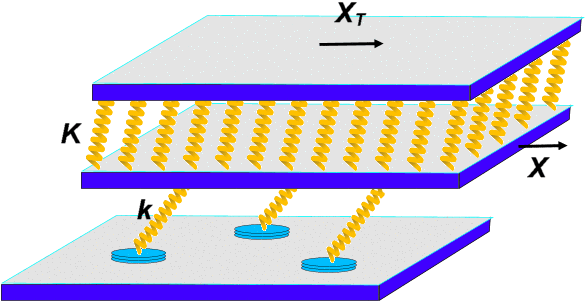 It
assumes that the interaction occurs through N asperities that
make contacts with the substrate. Each asperity is characterized
by its contact area Ai and an elastic
constant ki, schematized by an elastic
spring, which can be estimated from ki
~rc2√Ai,
where r is the mass density and c
is the transverse sound velocity of the material which forms the asperity. When
the bottom of the solid block is moved by X, the stretching
xi of an asperity, i.e. its elastic deformation
with respect to its relaxed shape, increases. The force at the contact grows as
fi=kixi
until it reaches the threshold value fsiµAi
at xsi=fsi /ki
µ √Ai;
at this point the contact rapidly slides, and fi
and xi drop to a small value before a
contact is formed again.
It
assumes that the interaction occurs through N asperities that
make contacts with the substrate. Each asperity is characterized
by its contact area Ai and an elastic
constant ki, schematized by an elastic
spring, which can be estimated from ki
~rc2√Ai,
where r is the mass density and c
is the transverse sound velocity of the material which forms the asperity. When
the bottom of the solid block is moved by X, the stretching
xi of an asperity, i.e. its elastic deformation
with respect to its relaxed shape, increases. The force at the contact grows as
fi=kixi
until it reaches the threshold value fsiµAi
at xsi=fsi /ki
µ √Ai;
at this point the contact rapidly slides, and fi
and xi drop to a small value before a
contact is formed again.
Let Pc(xs) be the normalized probability distribution of values of the thresholds xsi at which contacts break. Firstly we consider the model in the quasi-static limit where inertia effects are neglected (this restriction will be removed below). The distribution Pc(x) can be characterized by its average value xs and standard deviation ss; a typical example is the Gaussian distribution Pc(x)=G(x; xs,ss) = [1/s √(2p)] exp[-(x-xs)2/4s2].
To describe the evolution of the model, we introduce the distribution Q(x; X) of the stretchings xi when the bottom of the sliding block is at a position X. Let all asperities be initially relaxed or weakly stressed, e.g., let the distribution Q(x; 0)=Qini(x) be the Gaussian, Qini(x)=G(x; xini,sini) with xini=0 and sini<<ss. Now, let us adiabatically increase the displacement X of the bottom of the top sliding block while the base (the bottom substrate) remains fixed. The sum of the elastic forces exerted on the bottom of the block by the stretched asperities makes up the friction force
|
(eq1) |
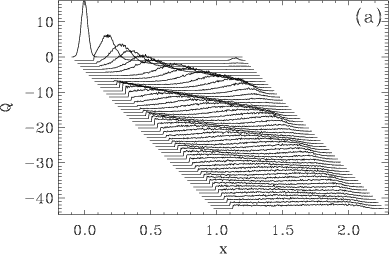
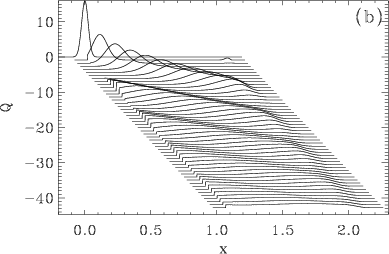
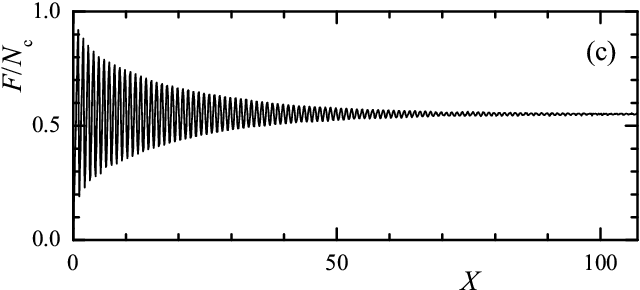
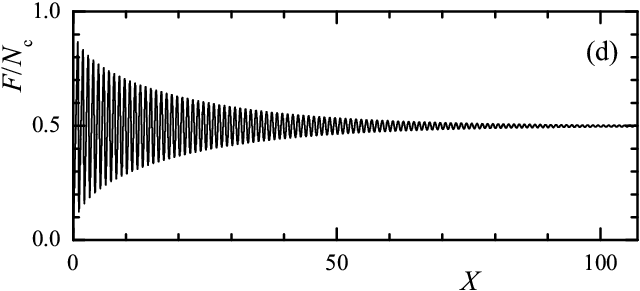
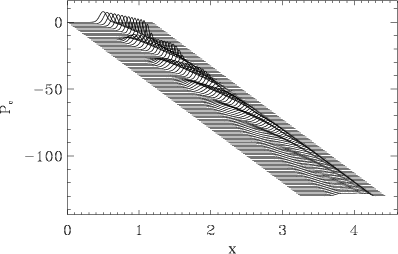
The evolution of the system, deduced from the numerical simulation of the EQ model, is presented in Fig.eq2a. It shows that, in the long term, the initial distribution approaches a stationary distribution Qs(x) and the total force F becomes independent on X. The final distribution is independent of the initial one (an elegant mathematical proof of this statement was given in Z.Farkas, S.R.Dahmen, D.E.Wolf, J.Stat.Mech.: Theory and Experiment P06015 (2005); cond-mat/0502644; the authors considered a simplified version of the EQ model, assuming that every contact keeps its own threshold value fsi unchanged after breaking/reforming); the statement is valid for any distribution Pc(x) except for the singular case of Pc(x)=δ(x-xs).
|
|
|
|
|
|
|
Figure eq2: (a) Evolution of the EQ model. The curves show the distribution Q(x; X) versus x for incrementally increasing values of X with the step DX»1.05. The distribution Pc(x) is Gaussian with xs=1 and ss=0.05, the initial distribution Qini(x) is Gaussian with xini=0 and sini=0.025 so that F(0)=0. (b) Solution of the master equation with the increment DX=1.09 for the same model parameters. Panels (c) and (d) show the dependences F(X) for ‹ki›=1 and K=∞ for EQ and ME, correspondingly. |
|
Master equation. Rather than studying the evolution of the distribution Q(x; X) by a simulation of the EQ model, it is possible to describe it analytically. Let us consider a small displacement DX>0 of the bottom of the sliding block (for DX<0 see below). It induces a variation of the stretching xi of the asperities which has the same value DX for all asperities if the deformation of the bottom surface of the block can be neglected. The displacement X leads to three kinds of changes in the distribution Q(x; X): first, there is a shift due to the global increase of the stretching of the asperities, second, some contacts break because the stretching exceeds the maximum that they can stand, and third, those broken contacts form again, at a lower stretching, after a slip at the scale of the asperities, which locally reduces the tension within the corresponding asperities. These three contributions can be written as a master equation for Q(x; X):
|
(eq2) |
|
(eq3) |
|
(eq4) |
|
(eq5) |
|
(eq6) |
Once the distribution Q(x; X) is known, we can calculate the friction force F(X) using Eq.(eq1). The static friction force corresponds to the maximum of F(X), i.e., Fs=F(Xs), where Xs is a solution of the equation F'(X)≡dF(X)/dX=0. In order to simplify the further consideration, let us assume that Pc(x)=0 for x≤0 (this agrees with its physical meaning because, if x<0, a positive variation DX actually reduces the absolute value of the force on a contact, which does not cause its breaking). Also we choose R(x)=δ(x), i.e., we assume that a broken contact sticks again only after a complete relaxation.
|
|
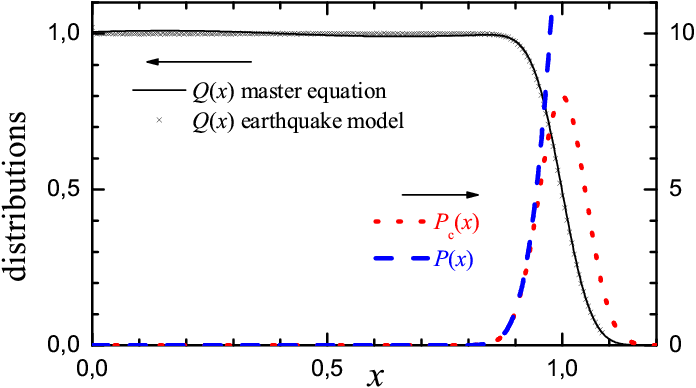
Figure eq3: The final distribution Q(x) for the parameters from Fig.eq2 (solid curve; crosses show the averaged final distribution for the EQ model).
The red dotted curve shows the distribution Pc(x), and the blue broken curve shows P(x) |
The steady-state, or smooth-sliding solution, i.e. the solution of Eq.(eq6) which does not depend on X, can easily be found. It can be expressed as
|
(eq7) |
where Q(x) is the Heaviside step function, EP(x)=e-U(x), U(x)=∫0x dx P(x), and C=∫0∞ dx EP(x). Note also the following useful relationships: U'(x)=P(x), EP'(x)=-EP(x)P(x), Jc(x)=EP(x), Pc(x)=P(x)EP(x) for x > 0, and EP(x)=1 for x≤0.
In the general case, let the distribution Pc(x) be of bell-like shape with the maximum at xs and the width ss. When X shifts for the distance xs, due to the breaking and reforming of contacts with a lower stretching, an initially peaked distribution Q(x; X) broadens by the value ~ss (Fig.eq2). Therefore, any initial distribution tends to the stationary one as |Q(x; X) - Qs(x)| µ exp(-X/X*), where X*~xs2/ss.
|
(eq55) |
|
(eq56) |
|
(eq57) |
|
(eq58) |
In particular, if xs=0, then Qs(x)=Q(x)pe-px and F=N‹ki›/p, while for the case of xs>0 and p®∞ we obtain that Qs(x)=xs-1 within the interval 0≤x≤xs and 0 outside it, so that F=1/2N‹ki›xs.
|
|
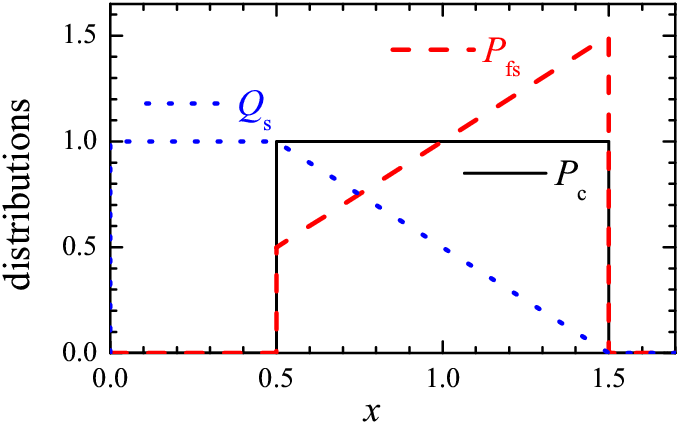
Figure eq25: The stationary distribution Qs(x) (blue dotted line) and the corresponding distribution of static thresholds Pfs(x) (red broken line) for the rectangular distribution Pc(x) (solid line).
Remark: the probability distribution Pc(x), which determines the static thresholds {xsi} for newborn contacts, is different from the concrete realization of the distribution of static thresholds Pfs(x), i.e., the histogram calculated over the array {xsi}: while at the beginning Pfs(x)=Pc(x), then the function Pfs(x) evolves with time. |
Another simple example which admits the exact solution, is the case of rectangular Pc(x) distribution shown in Fig.eq25:
|
(eq59) |
|
(eq60) |
|
(eq61) |
and the "rate" P(x) is given by
|
(eq62) |
In a general case the solution of master equation always approaches the steady-state solution corresponded to smooth sliding. However, there is one exception from this general scenario, when the model admits a periodic solution and F(X)≠Const even in the X®∞ limit. Namely, this is the singular case when all contacts are identical, i.e., all contacts are characterized by the same static threshold xs, Pc(x)=δ(x-xs), or P(x)=0 for x<xs and P(x)=∞ for x≥xs. In this case we can find (guess) the steady-state solution of the master equation (e.g., it may be checked by direct substitution):
|
(eq63) |
|
|
(eq64) |
The static friction force takes the minimal value Fs=1/2Nkxs for the uniform initial distribution Qini(x)=xs-1, when F(X) does not depend on X, and the maximal value Fs=Nkxs for the delta-function initial distribution Qini(x)=δ(x-x0) with some 0≤x0<xs, when the function F(X) has sawtooth shape changing from 0 to Fs.
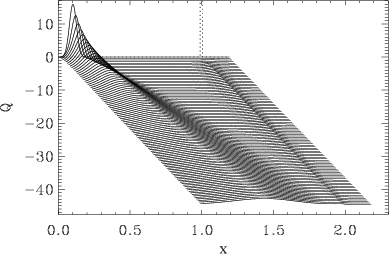
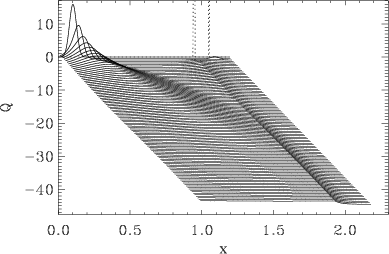
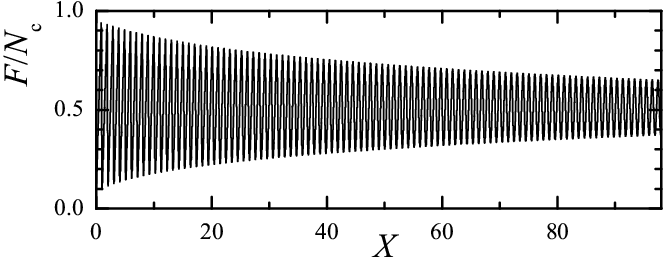
The periodic solution described above exists only for the distribution Pc(x) with the single threshold. If the contacts are characterized by more than one threshold value, for example, if one part of contacts has the threshold xs1 and another part, the threshold xs2≠xs1 [i.e., Pc(x) is described by a sum of two delta-functions], then the system will always approach the stationary steady state. This is demonstrated in Fig.eq26, where we compare the system evolution in cases of one-peaked and two-peaked Pc(x) distributions. Notice, however, that this statement is valid only for the infinite set of contacts (the number of contacts with each threshold must be infinite) and cannot be applied for the system where, e.g., two tips move over a surface.
 |
 |
 |
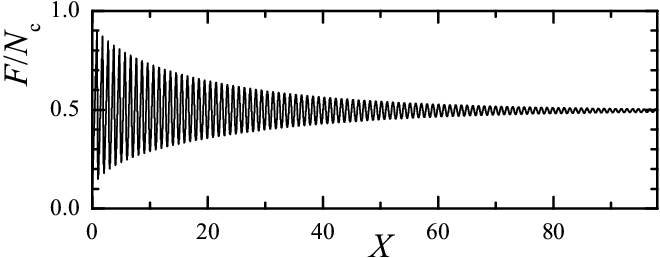 |
| Figure eq26: Evolution of the model for two examples of the Pc(x) distribution: Left coulomb is for one-peaked distribution of threshold, Pc(x)=G(x; x1,s) with x1=1 and s=10-3 (i.e., close to the delta-function distribution), and right coulomb is for two-peaked distribution of threshold, Pc(x)=1/2 [G(x; 0.95x1,s) + G(x; 1.05x1,s)] (i.e., close to the distribution with two delta-functions). Solid curves show the distribution Q(x; X) for incrementally increasing values of X with the increment DX»1, dotted curves show Pc(x) (for X=0 only). The bottom raw shows the corresponding dependences F(X) for ‹ki›=1 and K=∞. The initial distribution Qini(x) is Gaussian with xini=0.1 and sini=0.025. | |
Above we assumed that the slider moves continuously to the right, or DX>0. In the case when the top substrate moves to the left, DX<0, equations (eq3), (eq5) and (eq6) must be modified in the following manner:
|
(eq65) |
|
(eq66) |
|
(eq67) |
where for the symmetric case (the forward-backward symmetry) we have to put Pb(x)=P(-x) and Rb(x)=R(-x).
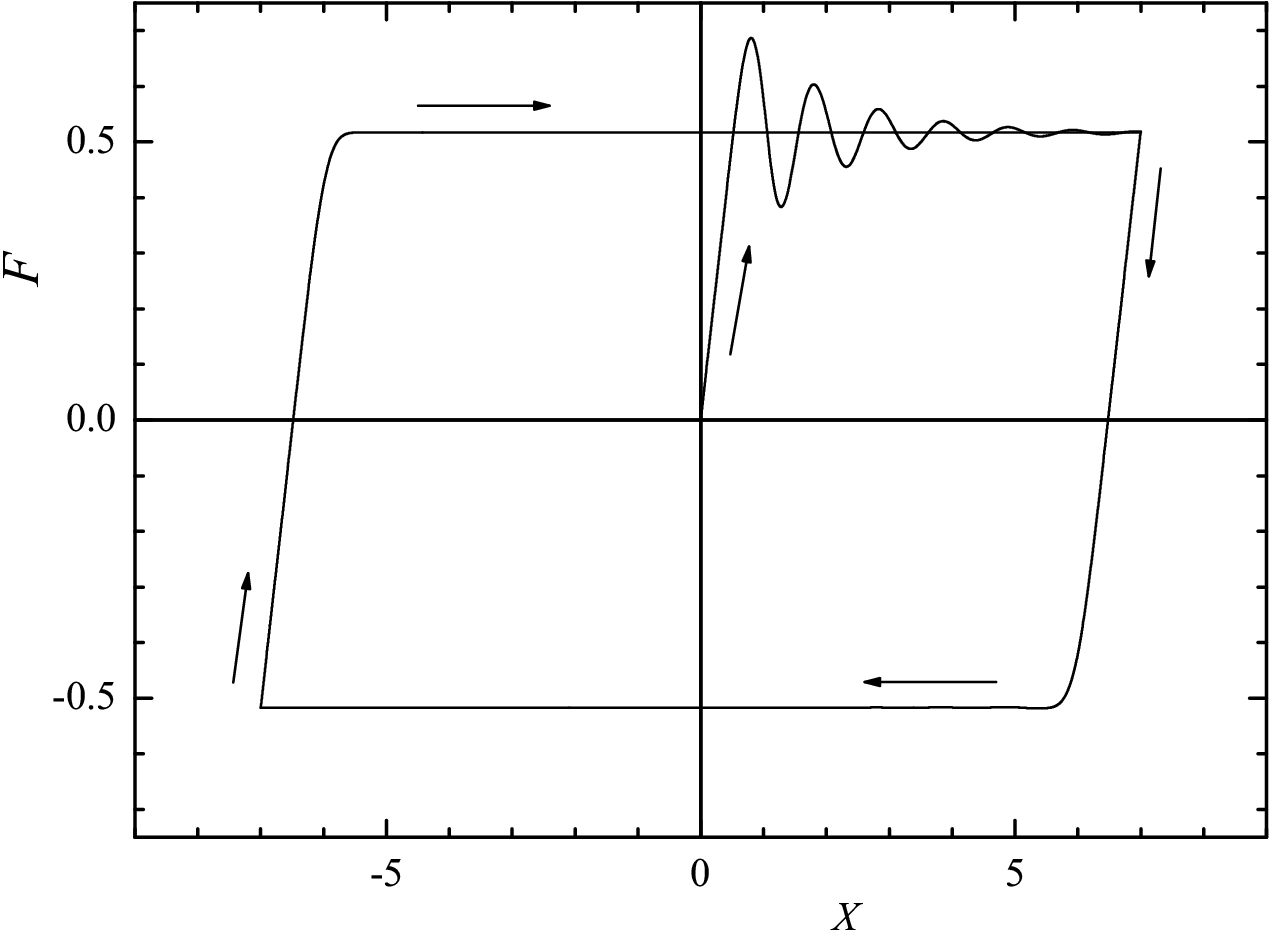
The reason for such a behavior is the irreversibility of the master equation. Equation (eq6) describes the "forward" dynamics when X increases, while Eq.(eq67) describes the "backward" dynamics when X decreases. Indeed, if the force fi on a given contact approaches and overcomes fsi, the contact breaks; but if we now reverse the motion direction, this contact cannot jump back to the value fi»fsi; instead, fi will decrease until it reaches the value fi»-fsi .
|
|
Figure eq27: Friction loop. The distribution Pc(x) is Gaussian with xs=1 and ss=0.2, the initial distribution Qini(x) is Gaussian with xini=0 and sini=0.025. The top substrate moves to the right, then to the left, and finally again to the right as indicated by arrows |
In a typical tribological experiment, the top substrate moves periodically forward/backward, and in the result, the so-called "friction loop" is obtained. The same loop can easily be calculated with the ME approach as demonstrated in Fig.eq27.
|
(eq68) |
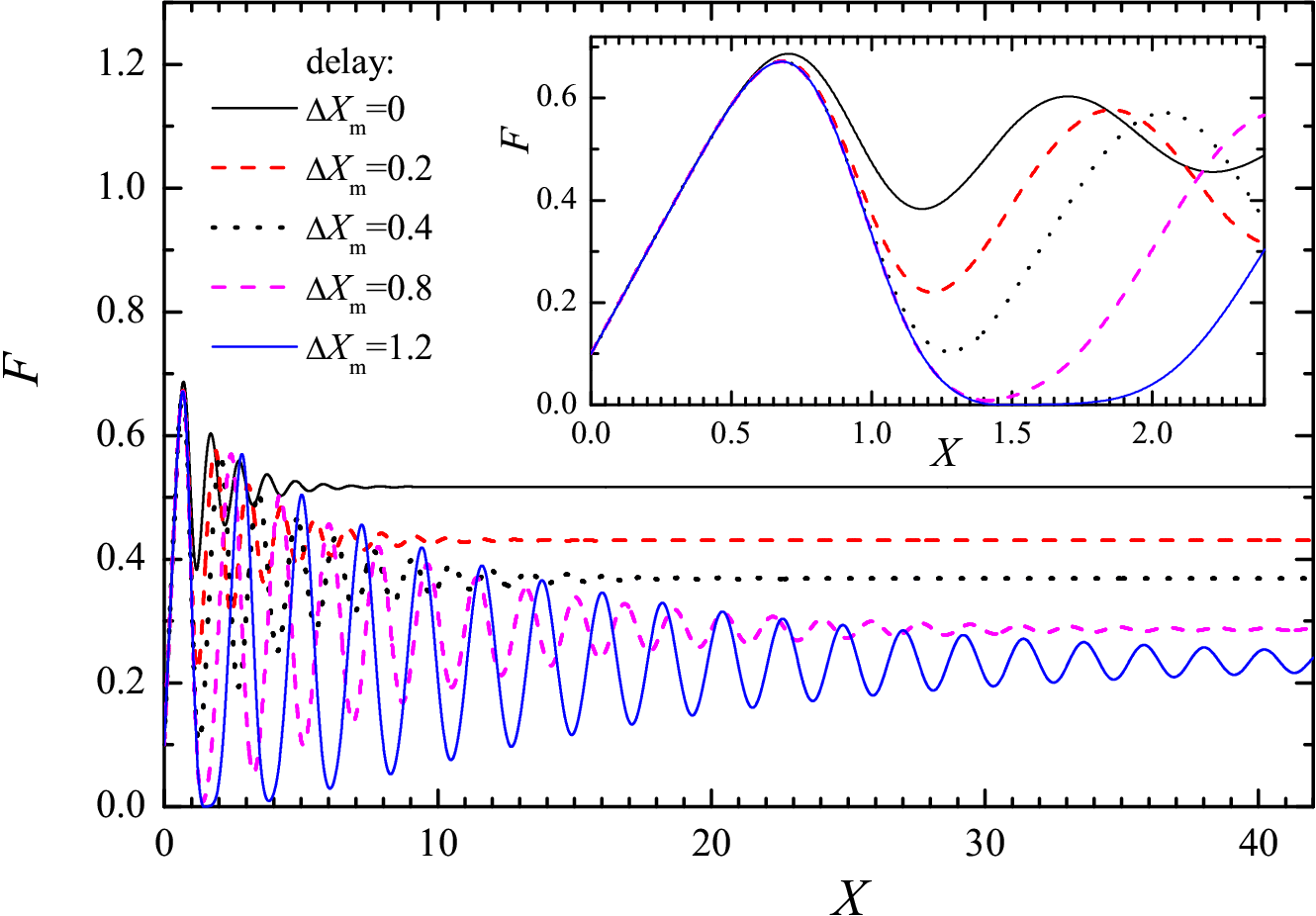 |
Figure eq28: The dependences F(X) for different delay times. The distribution Pc(x) is Gaussian with xs=1 and ss=0.2, the initial distribution Qini(x) is Gaussian with xini=0.1 and sini=0.025 |
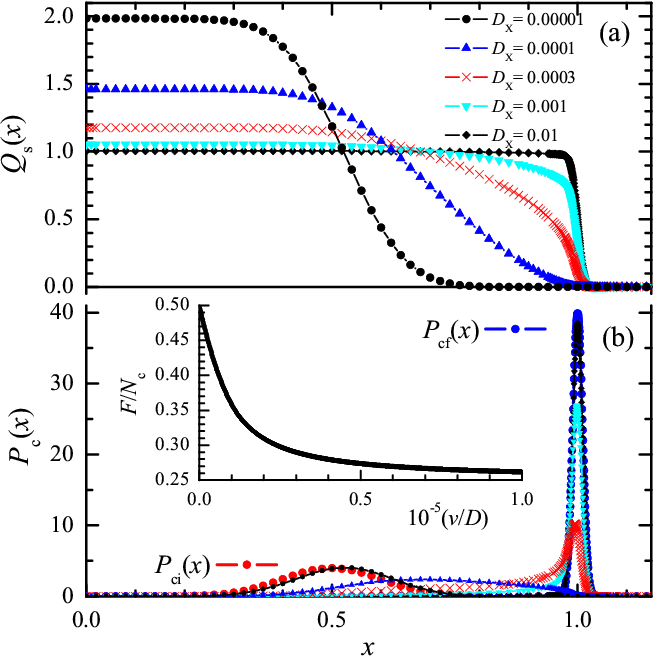
Now let us take into account the aging of contacts. Experiments as well as MD simulations indicate that the static friction force grows with the time of stationary contact (the waiting time tw, i.e., the duration of static contact prior to sliding). Thus, if the newborn contacts are characterized by a distribution Pci(x) with the average xsi and dispersion ssi, then typically xs grows while ss decreases with time, and at t®∞ the distribution Pc(x, t) approaches a distribution Pcf(x) with xsf >xsi and ssf <ssi. If we assume that the evolution of Pc(x) corresponds to a stochastic process, then it should be described by the Smoluchowsky equation
|
(eq28) |
the "diffusion" parameter D describes the rate of aging, B(x)=dU(x)/dx, and the "potential" U(x) is defined by the final distribution, Pcf (x) µ exp[-U(x)] so that
|
(eq29) |
Then, the equation ¶Pc/¶t = DLxPc naturally leads to the growth of the average static threshold from xsi to xsf with the time of stationary contact, as widely assumed in earthquakelike models of friction (e.g., see Eq.(Fs) in previous Chapter). At the same time, the contacts continuously break and reborn when the substrate moves, as described by third and forth terms in Eq.(eq6). Combining both the processes together, we come to the system of three equations:
|
where DX=D/v, and v=dX(t)/dt is the driving velocity. Thus, in the case of high driving (v®∞, DX®0) we obtain the previous behavior with Pc(x)=Pci(x), in the case of low driving (v®0, DX®∞) we again observe the same type of behavior but with Pc(x)=Pcf (x), and in the case of 0 < DX < ∞ we have an interplay of two processes – the aging which moves Pc(x) to Pcf (x), and the breaking/reborn process which returns Pc(x) to Pci(x) (see Fig.eq8).
|
|
Figure eq8: Evolution of Pc(x) due to two concurrent processes: the first is the aging of asperities from the initial (fresh) distribution Pci(x) (Gaussian with xsi=0.5 and ssi=0.05) to the final distribution Pcf (x) (Gaussian with xsf=1 and ssf=0.02), and the second is the break/reborn process. DX≡D/v = 5×10⁻⁴, the initial distribution Qini(x) is Gaussian with xini=0.1 and sini=0.025. The curves are plot with the increment DX=0.05
|
In the result, the friction force F now depends on the sliding velocity as shown in Fig.eq9.
|
|
Figure eq9:
(a) The final distribution Qs(x) for five values of the parameter DX=D/v: 10-5 (circles), 10-4 (up triangles), 3×10⁻⁴ (crosses), 10-3 (down triangles), and 10-2 (diamonds).
(b) The corresponding distributions Pc(x); larger circles show the initial distribution Pci(x) (red) and the final distribution Pcf (x) (blue).
Inset demonstrates the dependence of the kinetic friction force F in the steady state on the driving velocity v. Here ‹ki›=1, Pci(x) is Gaussian with xsi=0.5 and ssi=0.1, and Pcf (x) is Gaussian with xsf=1 and ssf=0.01.
Note: because typically xsi<xsf, the force F decreases when v grows, so that dF(v)/dv<0; that may lead to instability of the smooth sliding regime
|
Below we show that, if the sliding block is not rigid, K<∞, the system will demonstrate either stick-slip or smooth sliding depending on the distribution Pc(x). In this case the effect of contact's aging must lead to the transition from stick-slip to smooth sliding with the increase of the sliding velocity. The approach predicts, however, that this transition at v=vc is abrupt (first-order) contrary to what we observed in the EQ model with identical contacts. Moreover, the system should exhibit hysteresis: if the velocity decreases starting from the smooth-sliding regime, the latter will survive till much lower velocities v << vc.
Note: in the case of contact of rough surfaces, the physical mechanisms of contact aging, according to Baumberger and Caroli (2006), are the following: the first (and more important) mechanism is due to geometrical aging, or the increase of contact area at the asperity, and the second, due to structural aging, or restructuring of the contact. The value of the parameter D in Eq.(eq30) may be estimated from experiments which show that in most cases the average static threshold ms=Fs/Fload grows logarithmically with the waiting time tw, dms/d(ln tw) »10-2.
|
(eq36) |
|
(eq38) |
|
(eq39) |
|
(eq40) |
|
(eq41) |
and the function H(x) in Eq.(eq39) is determined by
|
(eq42) |
On the other hand, for "stiff", or "strong" contacts, when DE(0;xs) >> kBT, we have to substitute in Eq.(eq40) for the activation energy the expression DE(x; xs) = DE(0; xs) (1-x/xs)3/2, and also to renormalize the prefactor w, w ® w (1-x/xs)1/2. In this case the function H(x) is to be calculated as
|
(eq45) |
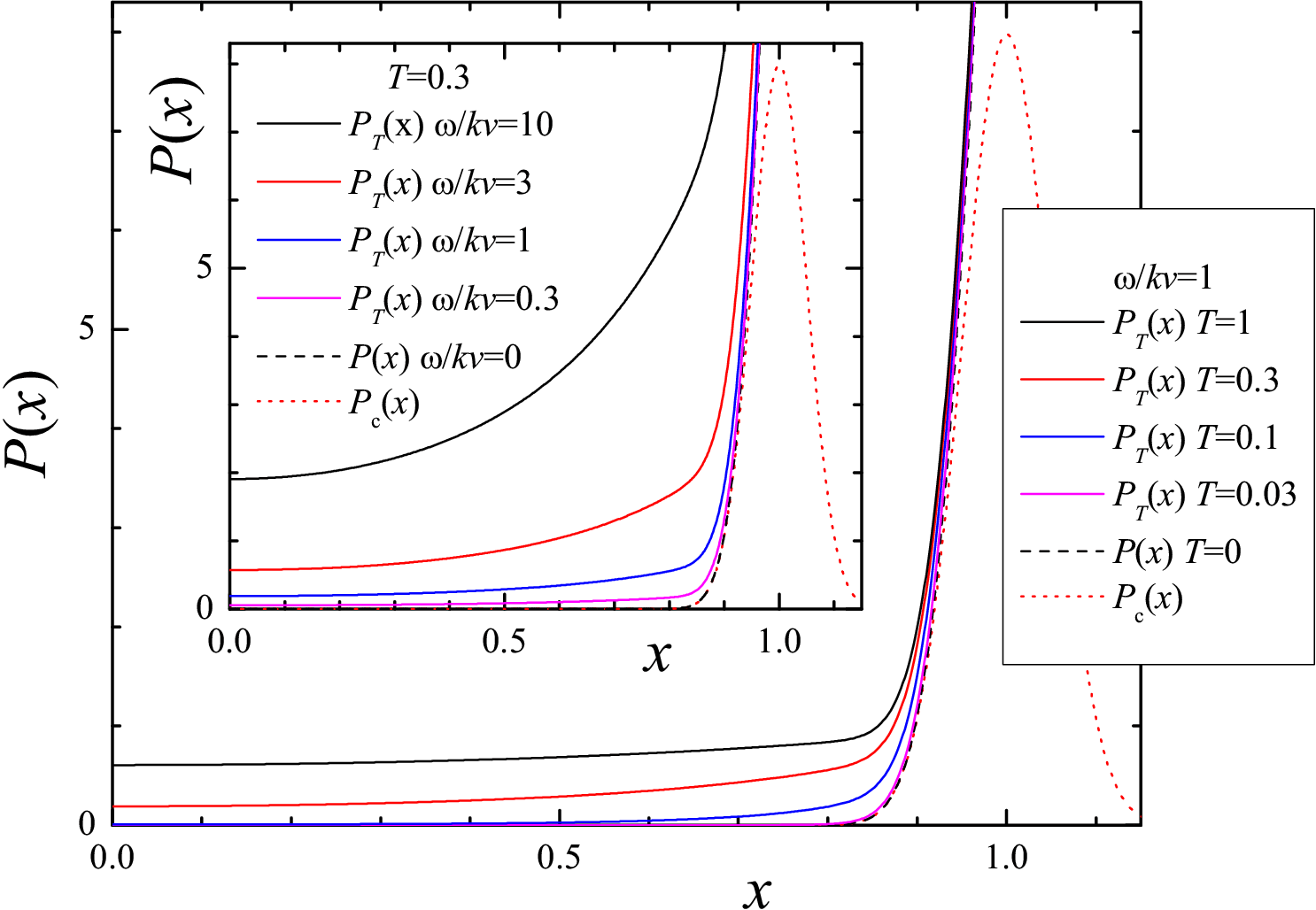
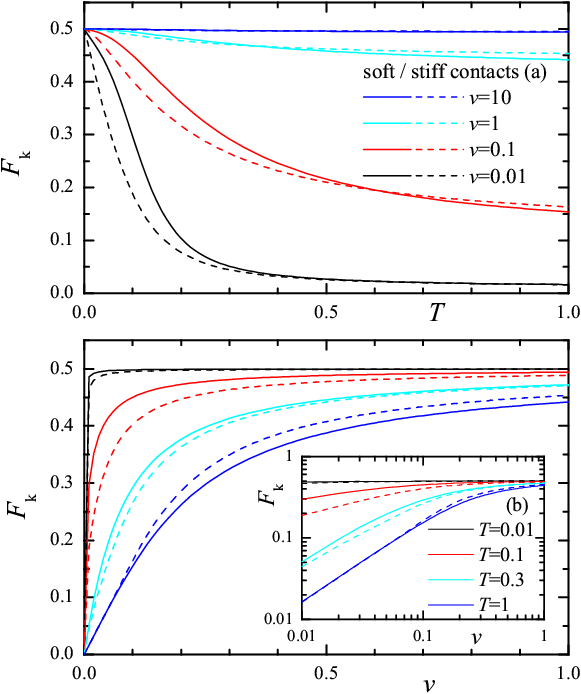
The contribution (eq42) or (eq45) to the rate PT(x) leads to appearance of a low-x tail. Its height grows with temperature as well as with decreasing of the driving velocity v as demonstrated in Fig.eq15. The increase of temperature leads to a shift of the distribution Q(x) to lower values, so that the friction force decreases when T grows. The effect is the larger, the lower is the sliding velocity as shown in Fig.eq16. In the limit v®0, all contacts will finally break if T>0, so that Qs(x)®δ(x) and Fk®0; in this limit we have "smooth sliding" corresponded to creep motion of contacts.
 |
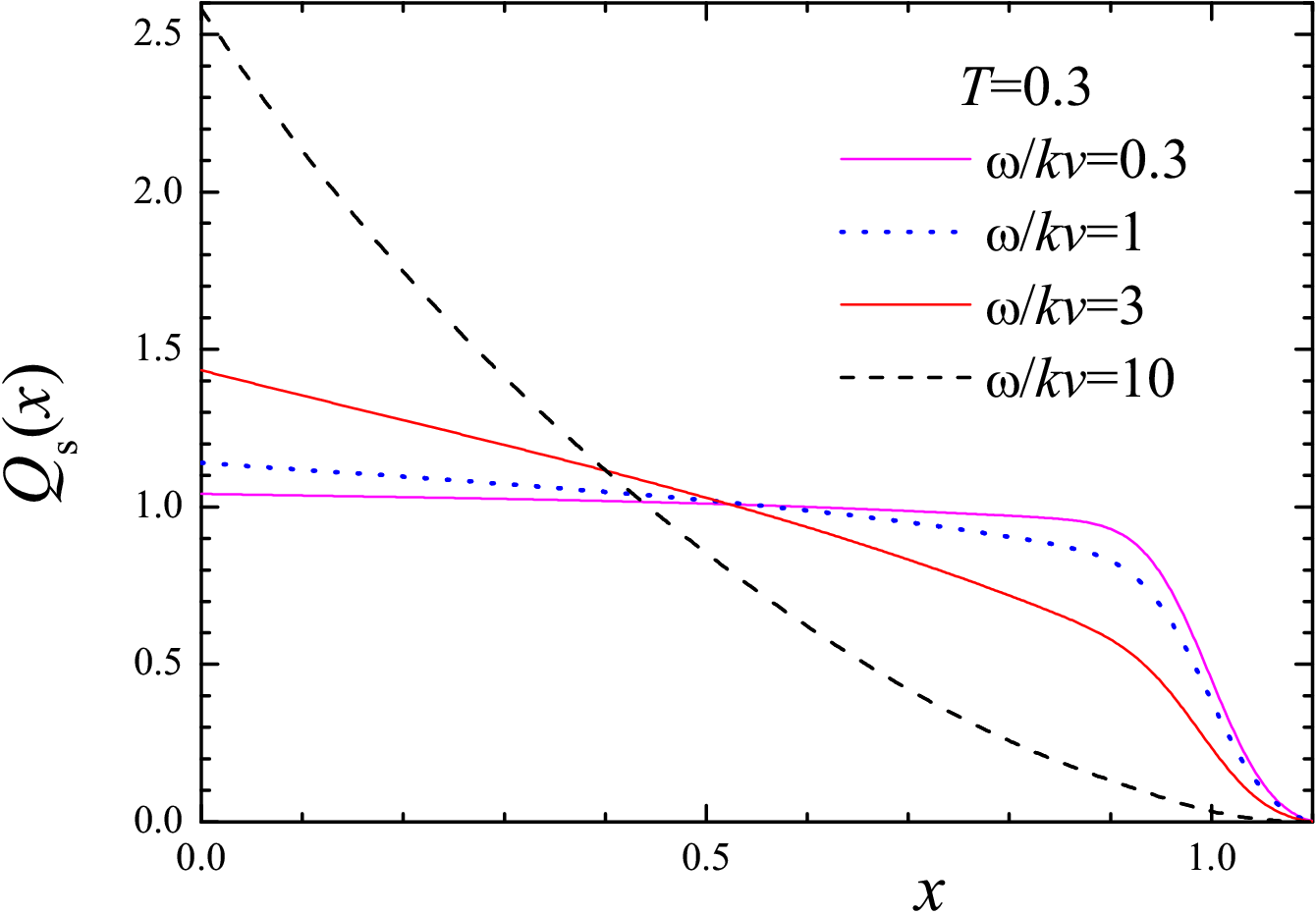 |
| Figure eq15: The rate PT(x) for soft contacts at different temperatures T=0 to 1 for a fixed velocity w/kv=1, and (inset) at different velocities, w/kv=0 to 10, for a fixed temperature T=0.3. Dotted curve shows the distribution Pc(x) (Gaussian with xs=1 and ss=0.05). | Figure eq16: The steady-state distribution Qs(x) for T=0.3 and different velocities (w/kv=0.3, 1, 3 and 10) for soft contacts. The distribution Pc(x) is Gaussian with xs=1 and ss=0.05. |
 |
 |
|
Figure eq17: (a) Dependence of the kinetic friction force Fk in the steady state on temperature for different velocities v=0.01, 0.1, 1 and 10. (b) Fk(v) for different temperatures T=0.01, 0.1, 0.3 and 1; inset shows the same in log-log scale. Solid curves are for soft contacts, and broken curves, for stiff contacts. The distribution Pc(x) is Gaussian with xs=1 and s=0.05; w/k=1. |
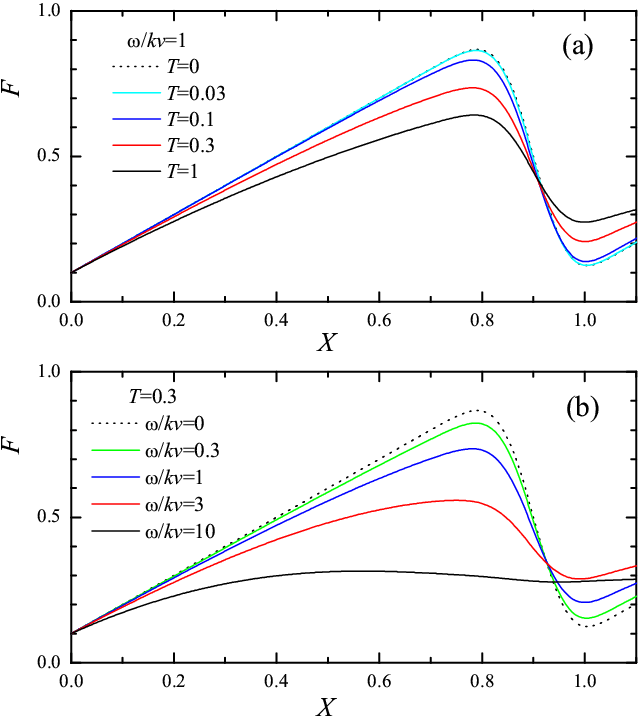
Figure eq19: The dependences F(X) for short X. (a) F(X) for different temperatures T=0, 0.03, 0.1, 0.3 and 1 at the fixed velocity w/kv=1; (b) F(X) for different velocities v, w/kv=0, 0.3, 1, 3 and 10 at the fixed temperature T=0.3. |
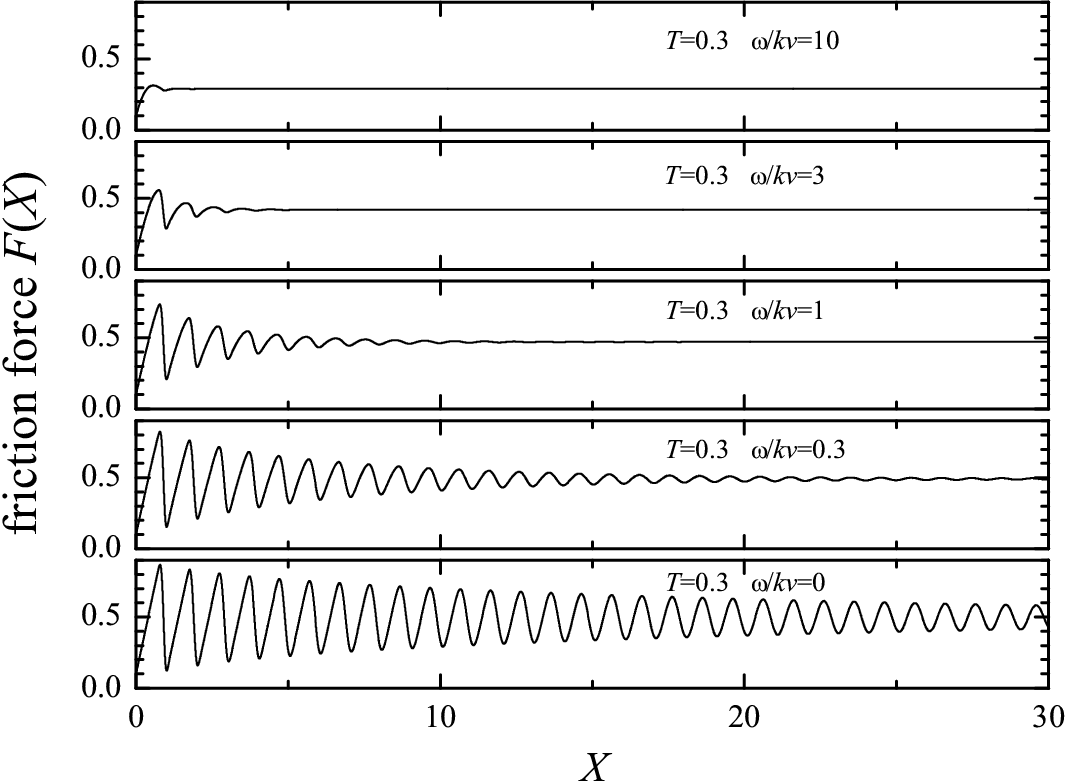
Nonzero temperature influences on the dynamics of approaching to the steady state (see Fig.eq18 and Fig.eq19). The higher is temperature and/or the lower is velocity, the lower is the static friction force Fs determined by the first maximum of F(X), and the faster F(X) approaches to the steady-state smooth sliding. Also it is important to consider the first cycle of the F(X) dependence, which defines the lowest value of F'(X). The higher is temperature, the lower is the extremum of F'(X) (see Fig.eq19a), so that the larger is the interval of model parameters where the smooth sliding regime operates. At the same time, the higher is driving velocity (Fig.eq19b), the smaller is the lowest value of F'(X), so that the narrower is the interval of model parameters where the smooth sliding regime operates (see below). Thus, we come to a surprising conclusion that at T>0 the decreasing of pulling velocity may lead to the transition from stick-slip to smooth sliding, i.e., the scenario just opposite to the conventional one.
|
Figure eq18: The dependences F(X) for T=0.3
at different driving velocities v,
w/kv=0,
0.3, 1, 3 and 10.
The distribution Pc(x) is Gaussian with xs=1 and ss=0.05, the initial distribution Qini(x) is Gaussian with xini=0.1 and sini=0.025 |
The described behavior of Fk on T and v qualitatively agrees with the tip-based experiments. Surprisingly, the dependences obtained within the ME approach, perfectly agree with the experimental ones for a "model" tribological system, where the kinetic friction of the driven lattice of quantized magnetic vortexes in high-temperature cuprate superconductors was studied (e.g., compare inset of Fig.eq17b with Fig.3 of Maeda et.al. Int.J.Mod.Phys. B 19 (2005) 463).
Let us discuss now physical origins of the distribution Pc(x). First of all, it can be coupled with the distribution Pcf (fs) of (static) friction force thresholds of the contacts. If a given contact has an area A, then it is characterized by the force threshold fsµA and the elastic constant k~rc2√A. The displacement threshold for the given contact is xs=fs/k, so that fs µ xs2, or dfs/dxs µ xs. Thus, using the relationship Pc(xs) dxs = Pcf (fs) dfs, we obtain
|
(eq47) |
For a contact of two hard rough surfaces (the multi-contact interface, or MCI in notations due to Baumberger and Caroli), the problem reduces to the statistics of asperities. Let the rough surface is characterized by hills of heights {hi} distributed with a probability Ph(h). Following the Greenwood and Williamson model of the interface, let us assume that all hills have the spherical shape of the same radius of curvature r. When this surface is pressed with another rigid flat surface, which takes a position at the level h0, then the hills of heights h>h0 will form contacts, or asperities. If the contacts are elastic (the Hertz contacts), then the contact of height h has the compression (h-h0), its area is pr(h-h0), and it bears the normal force fl(h)»(4p/3)E*r1/2(h-h0)3/2, where E* is the effective Young modulus (if both substrates have the same Young modulus E, then E*=E/2(1-n2), where n is the Poisson modulus). If we assume that the shear static threshold for the given contact is proportional to the load force, fs(h)»mfl(h), or
|
(eq48) |
where m<1 is a constant, then the distribution of static thresholds Pcf (fs) can be coupled with the distribution of asperities heights Ph(h) with the help of relation Pcf (fs) dfs µ Ph(h) dh, or Pcf (fs) µ (dh/dfs) Ph[h(fs)], where dh/dfs µ fs-1/3 according to Eq.(eq48).
For a strong load, when the local stress exceeds the yield threshold Y, the contacts begin to deform plastically. When all contacts are plastic, the local pressure on contacts is pload=H, where H is the hardness [ H»3Y for the spherical geometry of asperities; for metals H»(10-3-10-2)E ~ 109 Pa ]. Then the normal force at the contact is fl (h)»pr(h-h0)H. Assuming again that fs (h)»mfl(h), we obtain
|
(eq49) |
so that Pcf (fs) µ Ph[h(fs)]. For example, if the distribution of heights is exponential, Ph(h)=h0-1exp(-h/h0) Q(h), where h0 is the average height, then for the elastic contacts we obtain (f, x > 0)
|
(eq50) |
while for the plastic contacts
|
(eq51) |
|
|
|
|
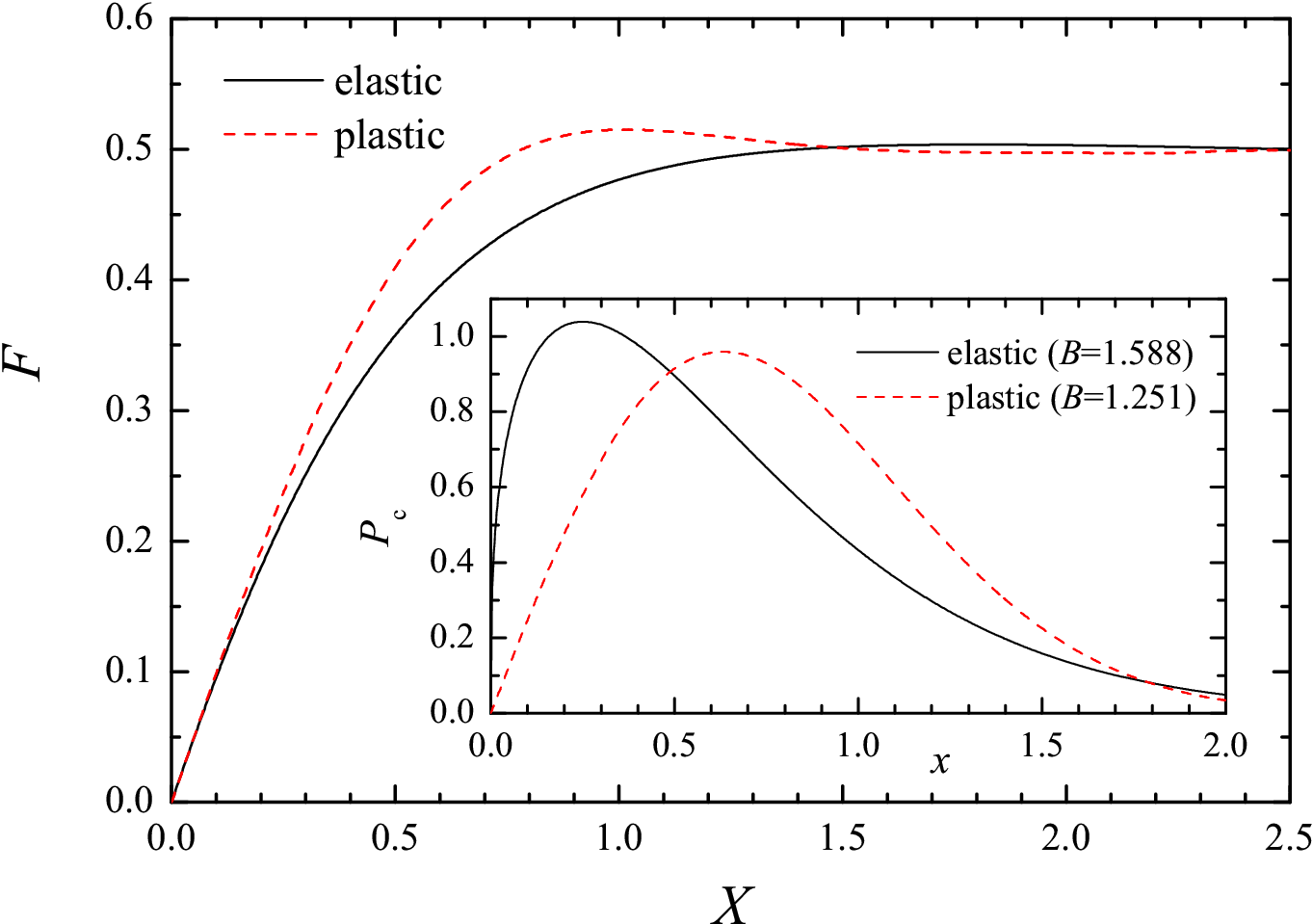
Figure eq20: Dependence of the friction force F on X for the elastic (B'=1.588, solid curve) and plastic (B''=1.251, broken curve) contacts. The initial distribution Qini(x) is Gaussian with xini=0 and sini=0.025. Inset shows the corresponding distributions Pc(x), Eqs.(eq50) and (eq51). |
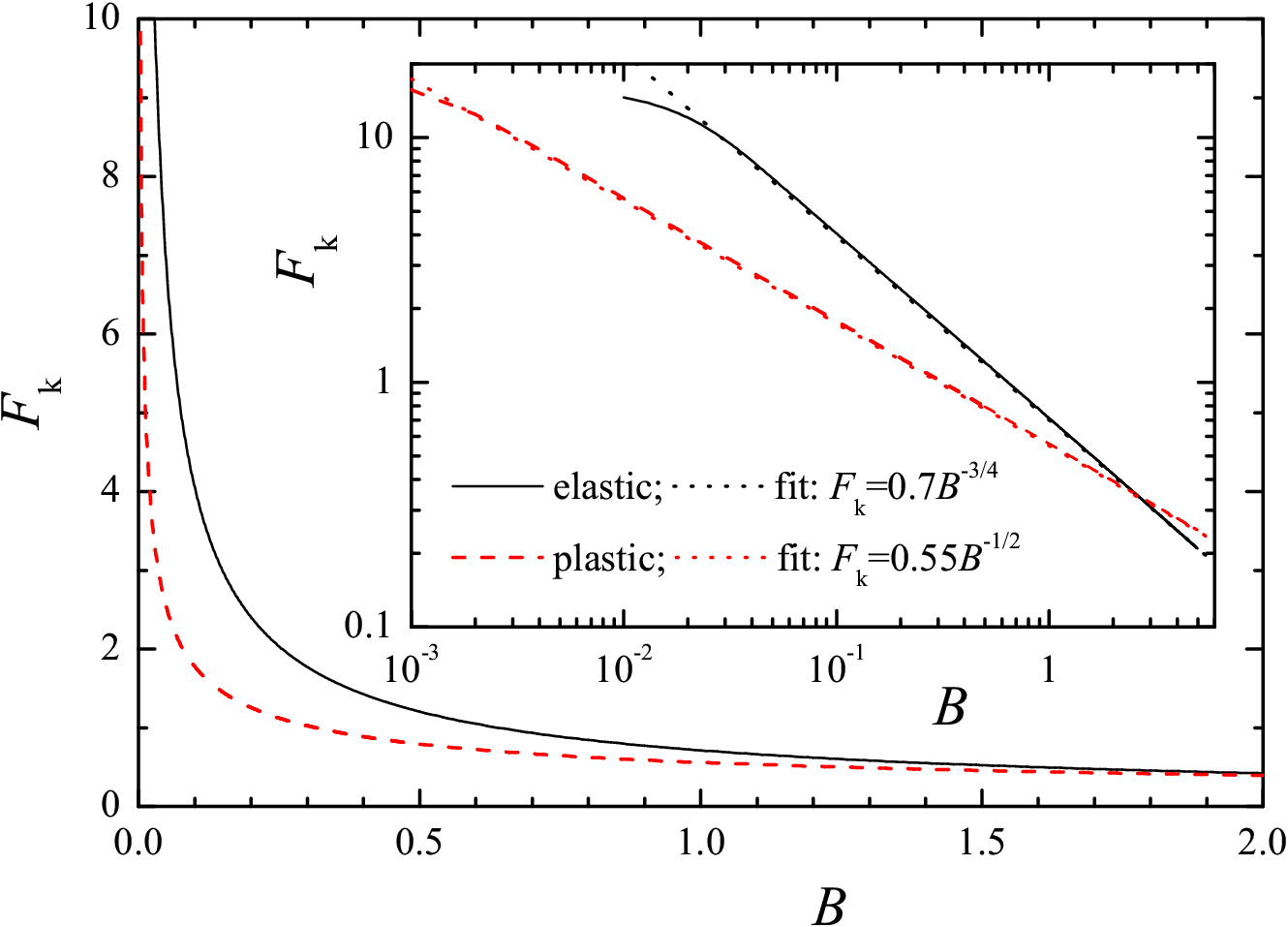
Figure eq21: Dependence of the kinetic friction Fk in the smooth sliding on the parameter B for the elastic (solid curve) and plastic (broken curve) contacts. Inset: the same in log-log scale; dotted lines show power-law fits. |
The distribution Pc(x) for the elastic and plastic contacts is presented in Fig.eq20. The force F(X) (almost) monotonically increases with X, approaching the kinetic value Fk. Thus, in the case of contact of rough surfaces, a relatively large concentration of low-threshold contacts prevents from appearance of the stick-slip motion even for a very soft substrates. The kinetic friction force Fk depends on the parameter B according to the power law (see Fig.eq21), Fk µ B-3/4 µ h03/4 for elastic contacts, and Fk µ B-1/2 µ h01/2 for plastic contacts.
Note: Typical values for rough surfaces are of the order r ~ 10 - 100 mm, h0 ~ 1 mm, so that the average size of the contact is a » rh01/2 ~ 3 - 10 mm. Are the contacts in the plastic or elastic regime, depends on the dimensionless parameter y=(E/Y)(h0/r)1/2: the former case operates for y>>1 (as is typical for metals), while the latter, for y<1 (it corresponds, e.g., to the case of rubber friction); the polymeric glasses belong to an intermediate situation, y>1, where only a fraction of contacts is plastic.
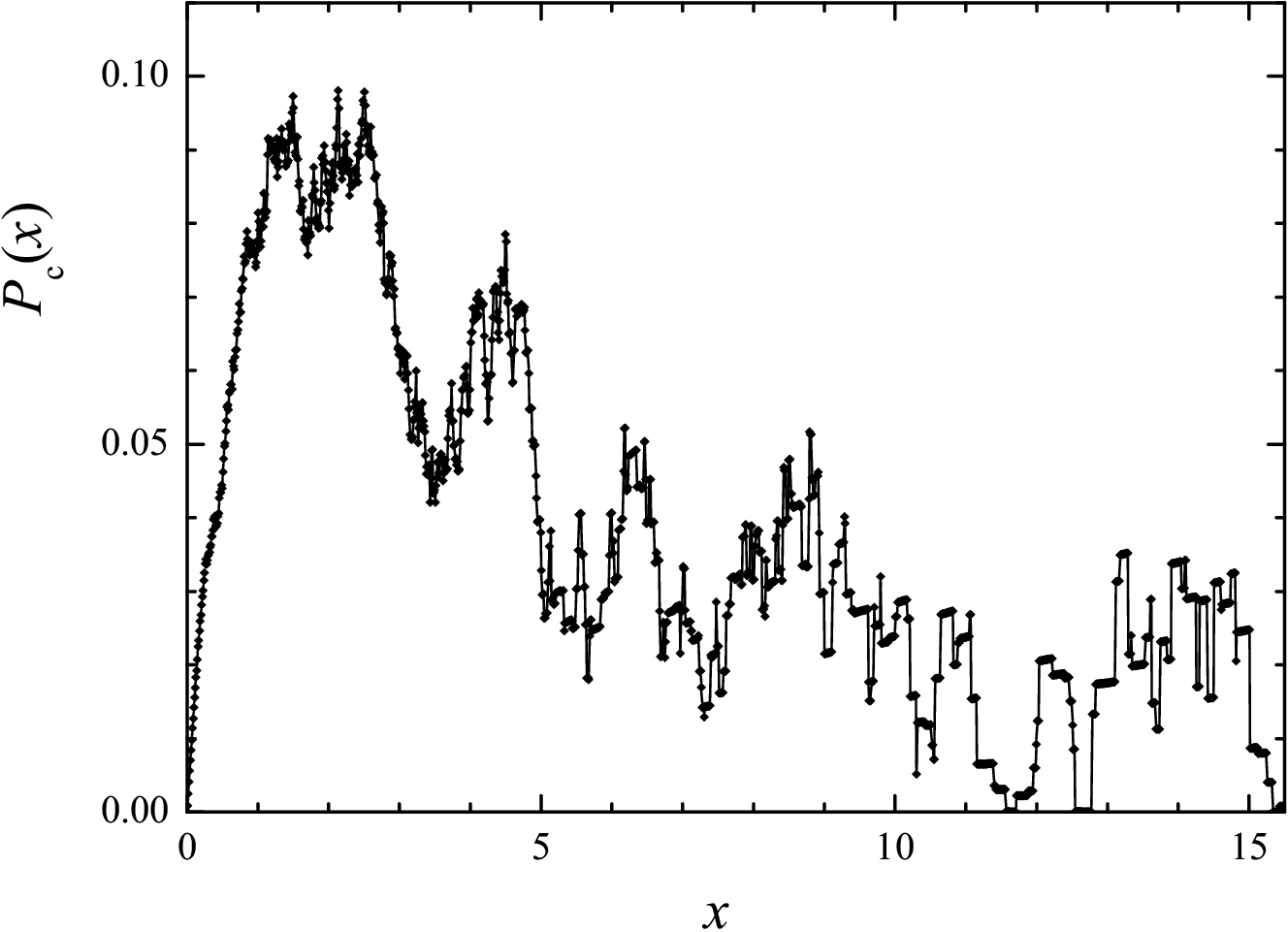
Next, let us consider the dry contact of two flat surfaces. In an exotic case when both surfaces have the ideal crystalline structure, we come to the singular case of delta-function distribution Pc(f). Such a situation, however, is exceptional. A real surface always consists of domains, which are characterized by different crystalline orientation and even, may be, different structure. MD simulations show a large variation of the friction with relative orientation of the two bare substrates. In order to estimate a shape of the function Pc(x) emerging due to domain structure of substrates, let us consider a simple model. Let a domain of the top rigid substrate be crystalline (e.g., of triangular symmetry) with the lattice constant a and consists of N atoms, while the bottom substrate be also rigid crystalline (e.g., with square symmetry) so that it produces a periodic potential for the motion of the top substrate. For some values of a and N, the activation energy for domain displacement is high, while for other values, the activation energy is small or even may vanish. Besides, if the domain is rotated on the misfit angle f, the activation energy should achieve minima at some angles.
For a fixed misfit angle f, one can calculate the total potential energy of the domain U(X,Y), where X and Y are the center of mass coordinates of the domain. The extrema of U(X,Y) are determined by the equations ¶U/¶X=0, ¶U/¶Y=0. An extremum may correspond either to a minimum Um or to a saddle point Us; then the activation energy is given by ea=Us-Um. Assuming that fs~ea/a µ ea, we can find the threshold force fs as a function of the misfit angle f and the domain size N. Then, calculating a histogram of the function ea(f), we obtain the distribution Pcf (fs) if all domains have the same size N and all angles are equally presented. Averaging it over different domain sizes N, e.g., with a weight function w(N)=e-N/‹N›, where ‹N› is the average domain size, we obtain the distribution Pc(x) shown in Fig.eq23 (note that it is similar to that of Fig.eq20 characteristic for rough surfaces).
|
|
Figure eq23: The distribution of static thresholds for domain structure of the substrate with ‹N›=50
|
Thus, in this system one also has to expect smooth sliding generally. However, in the estimation we assumed that the domains are rigid, while real substrates are deformable. Also, we supposed that all angles are equally presented, while some angles should have preference due to their lower potential energy. Both these factors should lead to the increase of the threshold values.
The dry-friction system considered above, is also exceptional. In a real system, almost always there is a lubricant between the sliding surfaces (called "the third bodies" by tribologists) – either a specially chosen lubricant film, or a grease (oil), or dust, or wear debris produced by sliding, or water or/and a thin layer of hydrocarbons adsorbed from air, etc.
In the conventional melting-freezing mechanism of friction, the lubricant is melted during slip, and solidifies when the motion stops. The solidification process can be described by the Lifshitz-Slözov theory. At the beginning, grains of the solid phase emerge within the liquid lubricant film. Then the grains grow in size according to the law ‹r› µ t1/3. The distribution of grains sizes is described as follows: the number of grains with the radius from r to r+Dr is equal to PLS(r/‹r›)Dr/‹r›, where the function PLS(u) is zero for u≥3/2 (i.e., the maximum size of the grains is 1.5‹r›), while for lower sizes it is given by
|
(eq52) |
Due to coalescence of grains, the total number of grains decreases with time as N(t) µ t-1. When the size of a grain exceeds the film thickness h (that will occur when ‹r›(t) ≥ h/3), such grains will pin the surfaces. Using the relationship Pcf (f) df µ PLS(r/‹r›) dr/‹r›, we obtain that Pcf (f) µ (dr/df) PLS(r/‹r›)/‹r›. Because one grain gives the static threshold proportional to the contacting area, fs µ p(r2-h2/4) for r>h/2, we have dr/df µ f-1/2. Combining all things together, we obtain that
|
(eq53) |
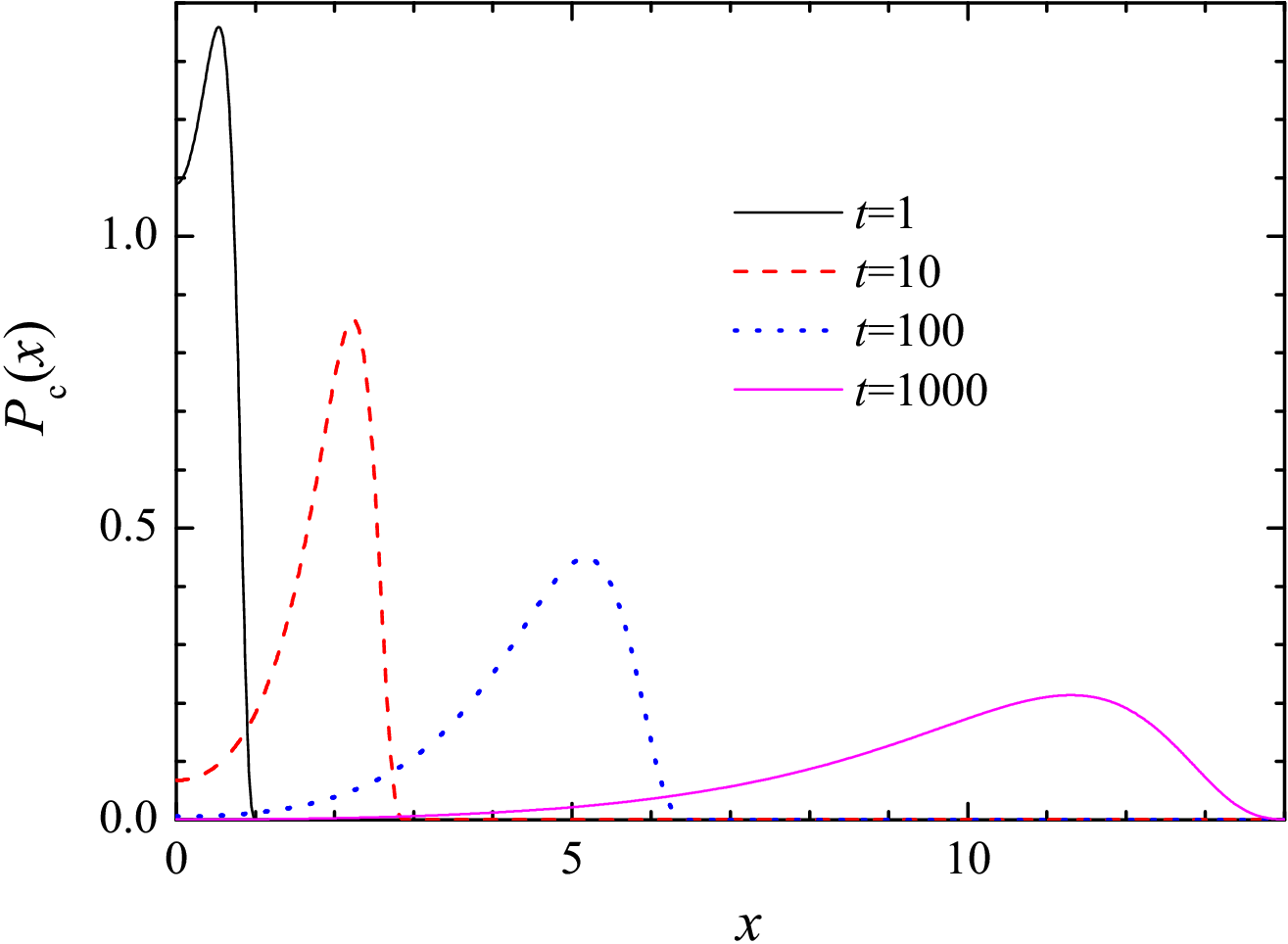
where r(t)=2‹r›(t)/h=at1/3 (the pinning begins when r>2/3), and B is determined by the system parameters (elasticity of the contacts, proportionality between the threshold fs and the contact area for a contact/domain/grain, and the thickness of the lubricant film). The distribution (eq53) is shown in Fig.eq24; it should lead to the conventional tribological behavior: the stick-slip motion at low driving velocity and smooth sliding at high velocities.
|
|
Figure eq24: Evolution of the distribution Pc(x) with the time of stationary contact for the Lifshitz-Slözov coalescence mechanism (a=1 and B=1) |
In a general case, we also have to take into account that the lubricant film may consist of grains (domains) of different orientation or even different structure. Indeed, the proportionality coefficient in the relation fs µ p(r2-h2/4) used above, should depend on the misfit angle between the lubricant domain and the substrate, so that the distribution PLS(u) introduced above, additionally should depend on the misfit angle f, PLS(u; f). Thus, if there are grains with different orientation, distributed according to a function Rf(f), then
|
(eq54) |
Above we described the rigid motion of the top substrate, when the ME solution always leads to smooth sliding. In order to describe a real dynamics of a tribosystem, we have to take into account the following three issues: (i) the slider inertia, (ii) the elastic instability, and (iii) the delay in contact formation.
Firstly,
we have to involve the motion equation for the slider; let it be modeled as a rigid entity
(a nonrigid slider will be considered below) of mass M (see figure to the right).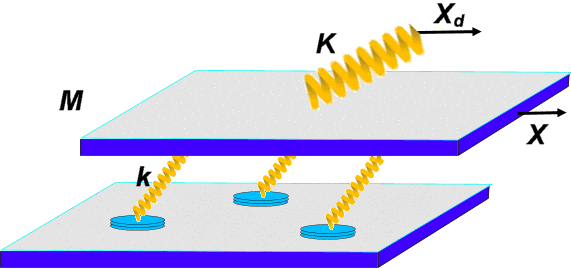 The slider is driven through a spring of the elastic constant K
with the velocity vd , so that the
(experimentally measured) spring force is Fd=K (Xd
-X), Xd=vdt.
Also the slider experiences the force -F
from all contacts as described above with the ME or EQ approach. Every contact
at the interface moves
rigidly with the slider so long as the total force fi<fsi,
where fsi is an upper threshold value. Above that
threshold the contact detaches from the slider and slips relative to it for a
delay time
td after which it stops and
attaches again to the slider; at this moment its stretching is determined from the condition that
the total force fi on the contact is equal
to the "backward" force fb~0.
The force F
from the interface on the slider is the sum of the forces from the pinned contacts, fi(sub)
=kixi
(recall that xi is the stretchings of the
contact and ki
is its elastic constant), plus additionally the sum of drag forces from the detached/sliding
contacts, fi(drag)
=-mihi [v-dxi(t)/dt
], where v(t)=dX(t)/dt is the
slider velocity, mi is the mass of the
contact and hi is the
corresponding damping coefficient (e.g., the "viscosity" of the molten
lubricant).
The slider is driven through a spring of the elastic constant K
with the velocity vd , so that the
(experimentally measured) spring force is Fd=K (Xd
-X), Xd=vdt.
Also the slider experiences the force -F
from all contacts as described above with the ME or EQ approach. Every contact
at the interface moves
rigidly with the slider so long as the total force fi<fsi,
where fsi is an upper threshold value. Above that
threshold the contact detaches from the slider and slips relative to it for a
delay time
td after which it stops and
attaches again to the slider; at this moment its stretching is determined from the condition that
the total force fi on the contact is equal
to the "backward" force fb~0.
The force F
from the interface on the slider is the sum of the forces from the pinned contacts, fi(sub)
=kixi
(recall that xi is the stretchings of the
contact and ki
is its elastic constant), plus additionally the sum of drag forces from the detached/sliding
contacts, fi(drag)
=-mihi [v-dxi(t)/dt
], where v(t)=dX(t)/dt is the
slider velocity, mi is the mass of the
contact and hi is the
corresponding damping coefficient (e.g., the "viscosity" of the molten
lubricant).
Because the slider is rigid, at any abrupt change of its motion, e.g., at the onset or stopping of motion, it will undergo vibrations with the setup frequency WS=(K/M )1/2, which cannot decay and therefore will disturb the results. In a real system, these oscillations will be attenuated because of internal friction inside the setup (i.e., due to phonon damping in the slider, when its bottom surface oscillates relative the top one). To incorporate such a damping, we introduce a viscous damping coefficient hS for the slider motion relative its average velocity, so that finally the slider motion equation is
|
(stick1) |
|
(stick2) |
Model parameters. In simulation results presented below we used the EQ algorithm (the ME approach leads to the same results). For the sake of quantitative results, we extracted model parameters from the experiment of Klein (J. Klein, Phys.Rev.Lett. 98 (2007) 056101), where the OMCTS (octamethylcyclotetrasiloxane) lubricant film of the thickness h=3.5×10⁻⁹ m (four molecular layers) between two atomically smooth mica surfaces was studied with the surface force balance (SFB) technique. Thus, we took M=1.47 g and K=97 N/m, that gives the setup frequency WS=257 s-1 and the period tS=2p/WS=0.0245 sec. Also we used A=10-10 m2 for the total contact area and Fs=18 mN for the static friction force. The damping coefficient for the drag force may be found from the bulk viscosity of OMCTS; this gives h=2×10¹¹ s-1. Assuming that there are N contacts at the sliding interface (N=4080 in simulation), we can find the parameters for individual contacts: Ai=A/N for the contact area, ai=√(Ai/p) for its radius, m=rOMCTSAih for its mass, fs=Fs/N for its static threshold, and a=(A/N)1/2 for the average distance between neighboring contacts. The contact elastic constant can be found as k»rc2ai; in simulation we took kN = 2000 N/m (note that it should be Nk>>K to have stick-slip). The static thresholds fsi for individual contacts take random values from the Gaussian distribution with the mean fs and standard deviation Dfs; other contacts' parameters are coupled with fsi by mi=mfsi/fs, ki=k (fsi /fs)1/2 and hi=h (when a contact reborn, its parameters are refreshed). Finally, we used hS=0.2WS , vd=0.1 mm/s, fb=0.1fs, Dfs=0.01fs, and td=5×10⁻⁴ sec (all the parameters were also varied in wide intervals).
Secondly, the master equation allows us to compute the force F(X) when the bottom of the solid block is displaced by X, but actually we don't control X. The displacement is caused by a shearing force Fd=K (Xd -X) applied on the top of the solid block which displaces the top surface by Xd. The total force applied to the bottom of the sliding block, which determines its displacement X, is the sum of the applied force and the force from the interface, Ftot=K (Xd-X) - F(X). This force can be viewed as deriving from the potential
|
(eq9) |
A necessary condition for smooth sliding is that Xd and X grow together with Xd-X=B, where B is a constant that measures the shear strain of the solid block during the sliding. It is determined by the condition ¶Veff/¶(Xd-X)=-¶Veff/¶X=0, which simply means that the total force on the interface vanishes. Smooth sliding also requires this state be stable,
|
(eq10) |
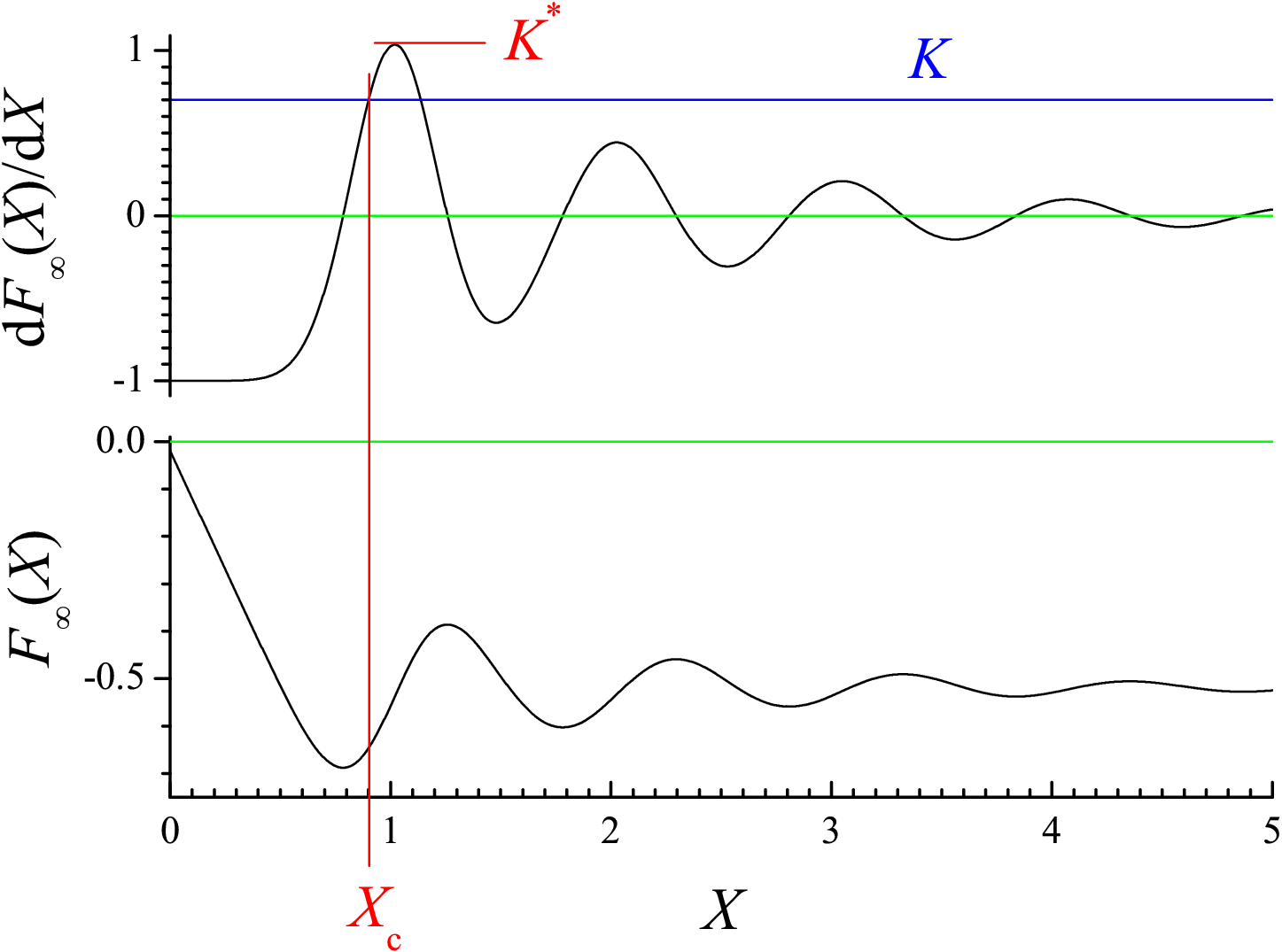
If we start from relaxed asperities, in the early stage of the motion F(X) is a growing function of X (see Fig.stick3), and then it passes by a maximum when some contacts start to break and reform at lower asperity stress. As a result F'(X)=dF/dX becomes negative. Depending on the value of K two situations are possible. For large K (K>K*= - max F'(X), stiff block) F'(X) never falls below -K and the smooth sliding is a stable steady state. For small K (K<K*, soft block) F'(X) can become smaller than -K so that the stability condition (eq10) is no longer valid (this is the well-known elastic instability, e.g., see T.Baumberger and C.Caroli, Advances in Physics 55 (2006) 279). The instability may cause Xd-X to change abruptly by a breaking of all contacts and a quick slip of the block before the contacts reform with relaxed asperities. If the process repeats itself, we have the stick-slip motion. The master equation, which gives F(X), can be used to compute the period of the stick-slip. However, the existence of a stick slip is not only determined by the stiffness K of the block, but also by the distribution Pc(x) of the static thresholds and the time of contact reforming, as is described below.
|
|
Figure stick3: The force F∞(X)=-F(X) versus the displacement X for Dfs/fs=0.2 (fs=1 and Nk=1). The oscillations are due to the alternate prevailing of contact breaking (F drops) and contact reforming (rises).
At the beginning F(X) grows linearly with X, F(X)=NkX, until it reaches a value ~Fs-DFs. Then the growth reduces and changes to a decrease during a displacement x*~Dfs/k till almost all contacts reborn. Then the process repeats with a smaller amplitude, and so on
|
Thus, if the slider is soft enough, K<K*, its motion becomes unstable at the point Xc, where Xc is the (lowest) solution of the equation F'(X)=-K (see Fig.stick3). Let this occur at the moment tc. After the unstable point, t>tc, the motion equation in terms of DX=X-Xc and Dt=t-tc is
|
(stick3) |
with the initial condition DX=0 and dX/dt=vd at Dt=0. In the EQ model with the distribution of static thresholds, the function F(X) near the point Xc can be approximated as F(X) » F(Xc) + F'(Xc) DX + (1/2)F''(Xc) DX2 + (1/6)F'''(Xc) DX3, so that
|
(stick4) |
Introducing the dimensionless variables x=K(X-Xc)/Fs and t=WS(t-tc), we obtain the following equation for the slider coordinate:
|
(stick5) |
where
|
Solution of Eq.(stick5) should be found with the initial condition x(0)=0 and dx(t)/dt|t=0 =D1. At short times, t<<1, the solution has the form x(t) » D1t + (1/6)D1t3. Thus, as X(t) grows at t>tc, the spring force quickly drops during a slip time ts»aWS-1 in the form
|
where a=(6FsWS /Kvd)1/3 (a»2.21 for the chosen set of parameters). Numerical solution of Eq.(stick5) is shown in Fig.stick4.
|
|
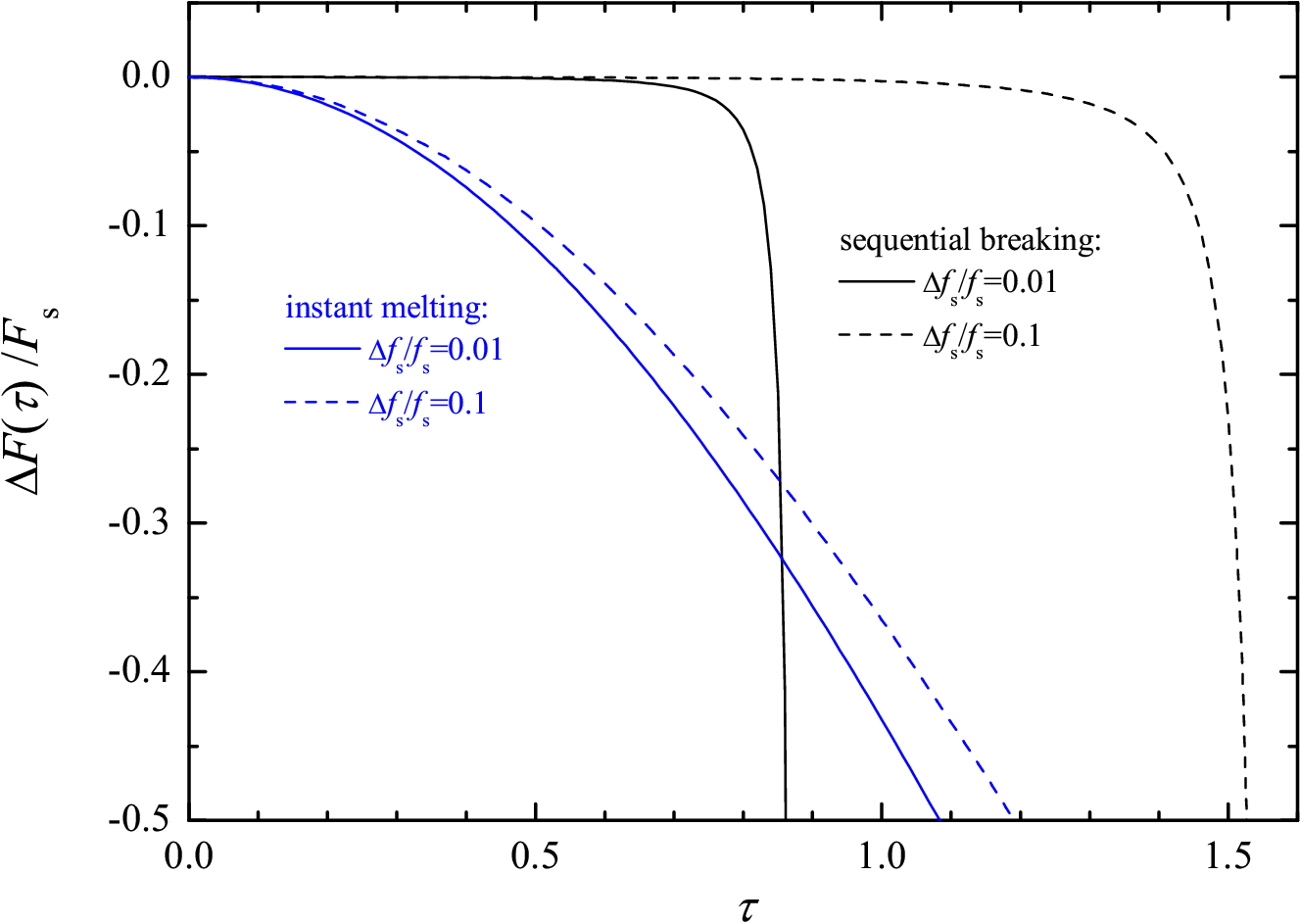
Figure stick4: Drop of the spring force DFd(t)/Fs=D1t-x(t) versus dimensionless time t=WS (t-tc) for the slider motion after the unstable point (X >Xc) according to numerical solution of Eq.(stick5) (black curves, sequential breaking of contacts) or Eq.(stick6) (blue curves, instant melting of the lubricant) for Dfs/fs=0.01 (solid curves; D0=0.94, D1=2.1×10⁻³, D2=2.2×10⁵, D3=1.91; h=hS=0) and Dfs/fs=0.1 (dashed curves; D0=0.794, D2=3.61×10³, D3=4.03×10⁻²)
|
On the other hand, if the whole lubricant film melts instantly at t=tc, then for t>tc we have F(Xc+DX) =Mh d(DX)/dt, and the motion equation in dimensionless variables takes the form
|
(stick6) |
where D0=-Fd(Xc)/Fs. Its solution for t <<1 is x(t) » D1t + Bt2, so that the spring force drops as
|
with B=(1/2)(D0-hD1/WS). This gives the slip time ts»b WS-1 with b=[2/(D0-hD1/WS)]1/2. Numerical solution of Eq.(stick6) is shown in Fig.stick4. One can see that in this case the slip time is much shorter; however, using artificially huge values for h, one may make ts as large as desired (see discussion).
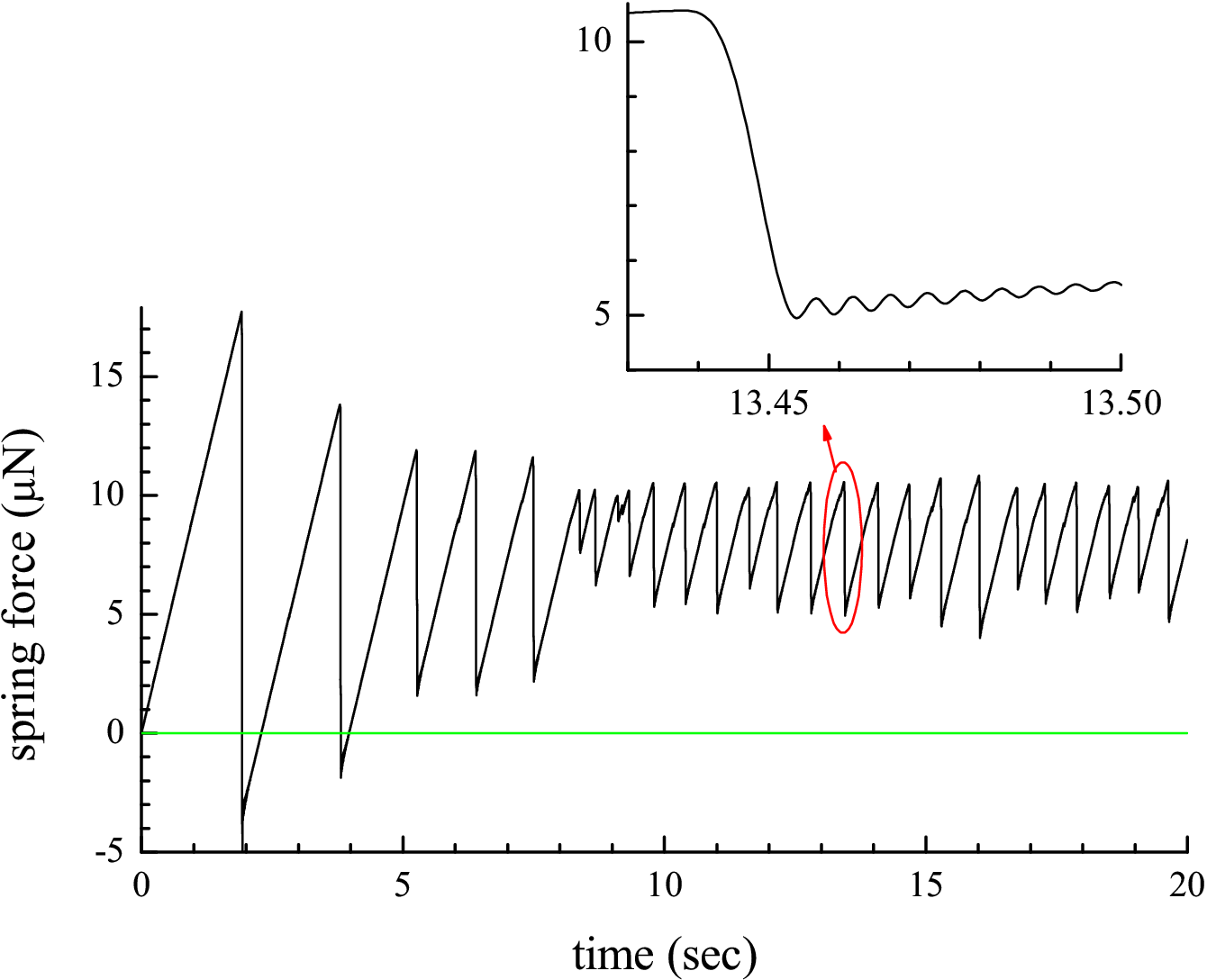
A typical example of stick-slip motion of the EQ model for the chosen set of parameters is presented in Fig.stick2. It is very similar to that observed experimentally, including the large initial stick spike and subsequent stick spikes of smaller amplitude (e.g., compare Fig.stick2 with Figs. 1 and 2 in Klein's paper).
|
|
Figure stick2: Calculated spring force in the stick-slip regime. The inset shows the detail of a slip, with the sudden force drop and mechanical ringing oscillations. |
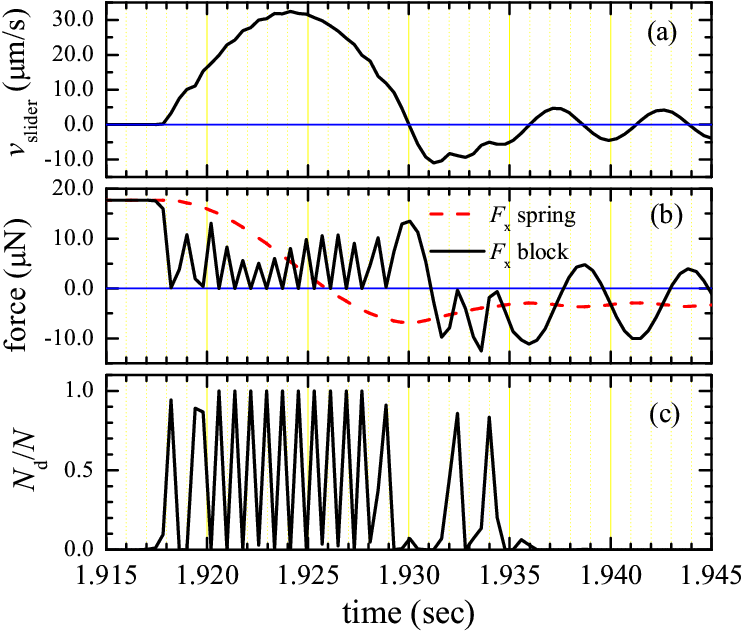
Details of the slip are shown in Fig.stick5. During the slip time ts, the slider velocity grows up to a value v~WSFs /K. As the slider accelerates, the contacts break, the number of detached contacts grows, and the force F(t) on the slider from the contacts drops from Fd(tc) to zero. After the delay time td, the contacts reborn, and F(t) grows as F(t)=Ct with the rate C=Nkvt back to the value ~Fd(t). Therefore, the force F oscillates with a period tB»Fs /Nkv»K/NkWS. Such oscillations exist provided tB<ts, or K<Nk.
|
|
Figure stick5: Details of the slip shown in Fig.stick2: (a) the slider velocity, (b) the spring force Fd (red dashed curve) and the force F from the contacts (black solid curve), and (c) the number of detached contacts Nd as functions of time.
|
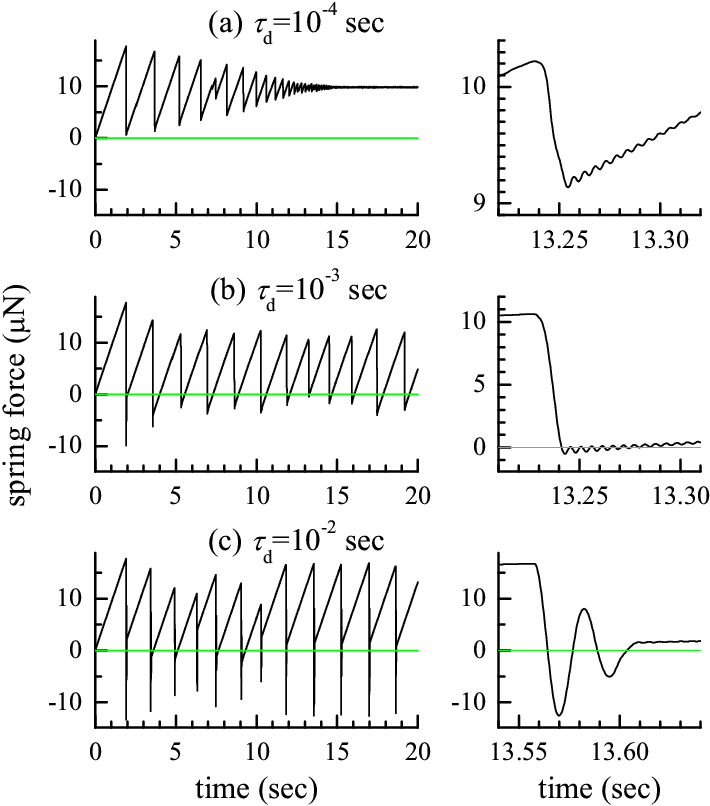
Thirdly, let us consider the role of delay time. One may think that the elastic instability will result in stick-slip motion. However, the condition K<K* is the necessary but not sufficient one for stick-slip; the second necessary condition is a nonzero delay time, td>0. This is clearly demonstrated in Fig.stick6: if td=0, the system still approaches the smooth sliding.
|
|
Figure stick6: Spring force Fd(t) for different values of the delay time td. Despite the soft spring constant K=97 N/m << K*=4.34×10⁴ N/m, stick-slip is only found for sufficiently large td |
The subsequent (after the slip) motion of the slider depends on a value of the parameter td. If td>WS-1, the spring force drops to negative values and then oscillates around zero with the frequency WS during the time td (Fig.stick6c). Otherwise, if td<<WS-1, the spring force drops to a value higher than Fb and then begins to grow, oscillating with a high frequency WL=(Nk/M)1/2=1.17×103 sec-1 (so that 2p/WL=5.39×10-3 sec; see Fig.stick6a and Fig.stick6b). In all cases, the ringing vibrations decay as e-hSt.
If we neglect ringing oscillations, then the dependence Fd versus vdt is "universal". Thus, if the velocity is so small that tss >> hS-1, i.e., the oscillations are completely damped during the time per stick-slip cycle tss, the amplitude of stick-slip variation remains the same. But if the driving velocity is so high that tss<hS-1, then the oscillations will disturb the system dynamics and may lead to smooth sliding.
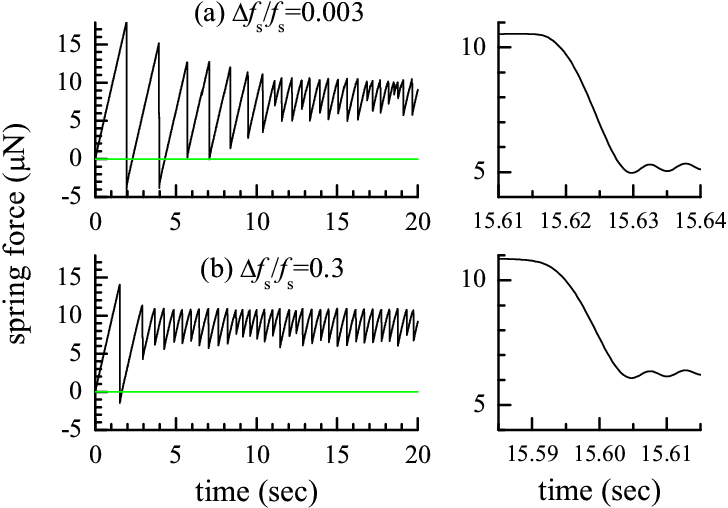
Role of threshold's dispersion. The system behavior (either stick-slip or smooth sliding) is controlled by the dispersion Dfs. Indeed,
|
(stick7) |
Thus, if Dfs is so small that K*>K, then the motion corresponds to stick-slip; otherwise the smooth sliding regime is achieved. In the stick-slip regime, an increase of Dfs leads to the decrease of the period tss of stick-slips as demonstrated in Fig.stick8. The time ts of the F(t) drop during slip also increases with Dfs, but this effect is rather small.
|
|
Figure stick8: Dependences Fd(t) for different values of the dispersions Dfs
|
Finally, note that the ratio Dfs/fs should decrease with the time of stationary contact due to aging of contacts; namely this aging is responsible for the transition from stick-slip to smooth sliding with the increase of driving velocity.
Role of slider
elasticity. Above
we have assumed that the slider is a rigid body; in a real setup, however, both the
slider
mass and its elasticity are distributed through the slider.
One
may think that in this case, only the most bottom atomic layer of the slider
starts to move at the onset of slip. Therefore, a characteristic frequency will
be determined by the mass Ml of the layer and
its elastic constant Kl; this could lead to a much
higher (atomic scale) frequency. A similar question
– which mass, either the total mass M or the layer
mass Ml, defines the time scale of the
system? – appeared in the problem of minimal
velocity for the atomic-scale smooth sliding. As was
proven, when the slider velocity decreases, first the most bottom layer
stops; then the stopping wave emerges and takes away the kinetic
energy of the slider. In a result, the time scale of that problem is determined
by the layer mass Ml, and the minimal
velocity is of atomic-scale order (m/s).
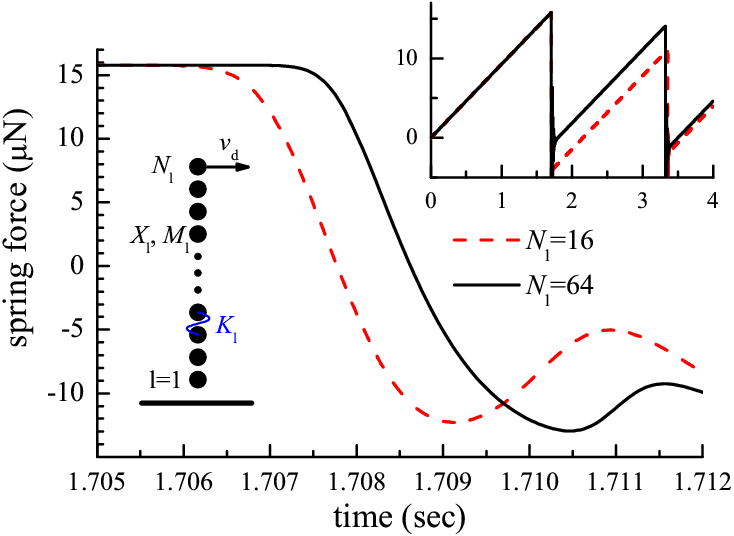
Now, however, the situation is just opposite. To show this, let us consider the slider as consisting of Nl layers, each of the mass Ml=M/Nl, elastically coupled by springs of the elastic constant Kl=KNl (see inset in Fig.stick19). Indeed, if we fix the bottom layer and apply a force F to the top layer, then the latter will shift on the displacement DX=∑l=1Nl DXl, where DXl =F/Kl, so that DX=F/K as before. Now let the top layer be driven with the velocity vd, while the bottom layer be in frictional contact with the bottom substrate. The dependence of the elastic force in the slider on time, obtained with simulation for two different values of Nl, is shown in Fig.stick19 (note that now we may not use the artificial damping hS, because internal degrees of freedom are included). As seen, the slip kinetics is almost independent on the number of layers Nl and is determined by the minimal slider mechanical frequency WS.
|
|
Figure 19: Slip kinetics for the nonrigid slider consisting of Nl=16 (dashed) or Nl=64 (solid curve) layers (top inset shows the whole stick-slip cycle; hS=0). Bottom inset shows the layered model of the slider: the first layer is in contact with the bottom substrate, while the last layer is moved with the velocity vd |
The frequency WS can be found with the help of elastic theory. Let the slider have a cylinder shape of height L and radius r, and is characterized by the section S=pr2, inertial momentum I=pr4/4, mass density r and Young modulus E. If the cylinder foot is fixed and a force F is applied to its top, the latter will be shifted on the distance DX=FL3/3EI (the problem of bending pivot, see Sec.20, example 3 in the Landau and Lifshitz (LL) textbook). Thus, the effective elastic constant of the slider is K=3EI/L3. The minimal frequency of bending vibration of the pivot with one fixed end and one free end, is given by WS=(3.52/L2)(EI/rS)1/2 (see Sec. 25, example 6 in LL). Taking M=rSL, we finally obtain WS»2.03√(K/M).
Finally, let us consider the role of interaction between the contacts. A concerted, or synchronized breaking (triggering) of contacts may be studied numerically only within the earthquakelike model, it cannot be included accurately in the ME approach (although it may be incorporated indirectly in a mean-field fashion by renormalization of the distributions Pc(x) and R(x)).
The elastic interaction between contacts separated by a distance r is described by the pairwise potential V(r)=g/r3, where g is a constant. Using ¶V/¶x=V'(r) ¶r/¶x, V'(r)=dV/dr=-3g/r4 and ¶r/¶x=x/r, we obtain that the force acting on the ith contact from its nearest neighbors (NN), is equal to
|
The interaction becomes important, when g/a3~fsa, where a is the average distance between NN contacts; therefore, it is interesting to check, how the system behavior changes with the dimensionless parameter x=g/(fsa4).
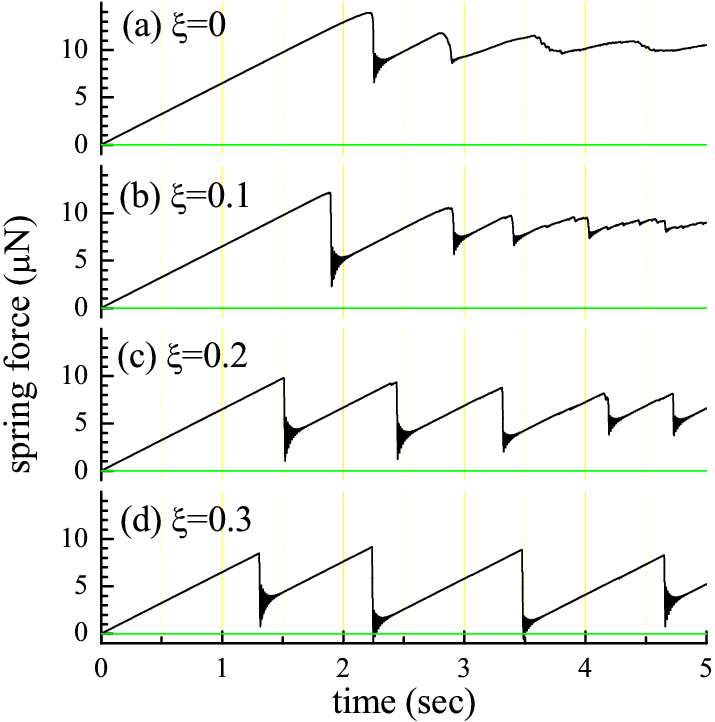
The interaction between the contacts works roughly in the same way as the dispersion Dfs: the stronger is the interaction, the wider is the range of model parameters where stick-slip operates. To demonstrate this effect more clearly, we calculated the system kinetics with increasing interaction (x=0 to 0.3) for softer contacts (kN=200 N/m) and a larger dispersion Dfs/fs=0.3. The results are presented in Fig.stick11. For these parameters, the system quickly goes to smooth sliding for noninteracting contacts (Fig.stick11a), but demonstrates stick-slip for a strong interaction x=0.3 (Fig.stick11d).
|
|
|
|
Figure stick11: Dependence of the spring force Fd(t) on time for different strengths of the interaction x for kN=200 N/m and Dfs/fs=0.3. |
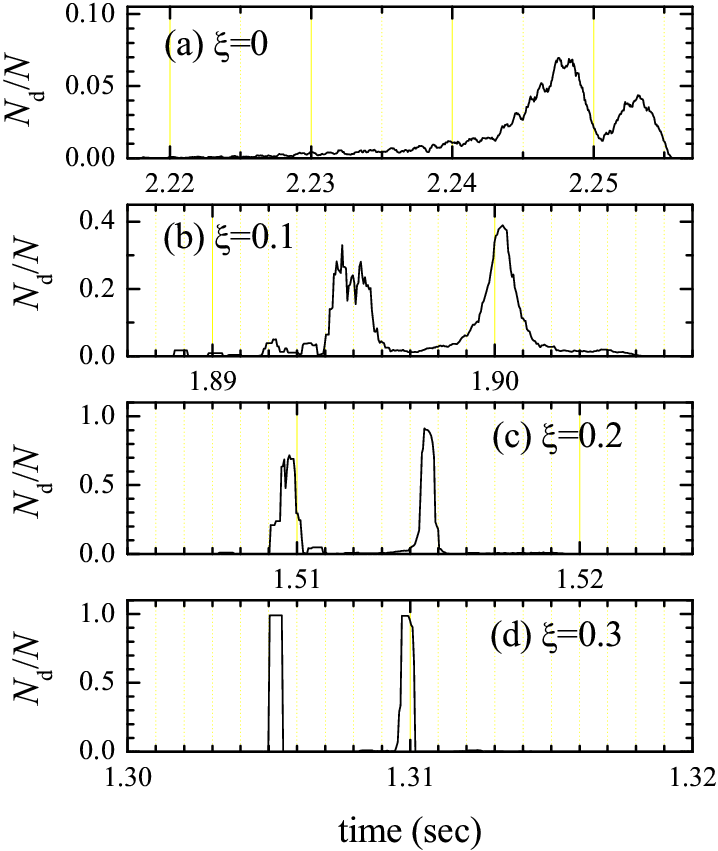
Figure stick13: Dependence of the number of broken contacts Nd(t) on time during slip for different strengths of the interaction. Parameters as in Fig.stick11. |
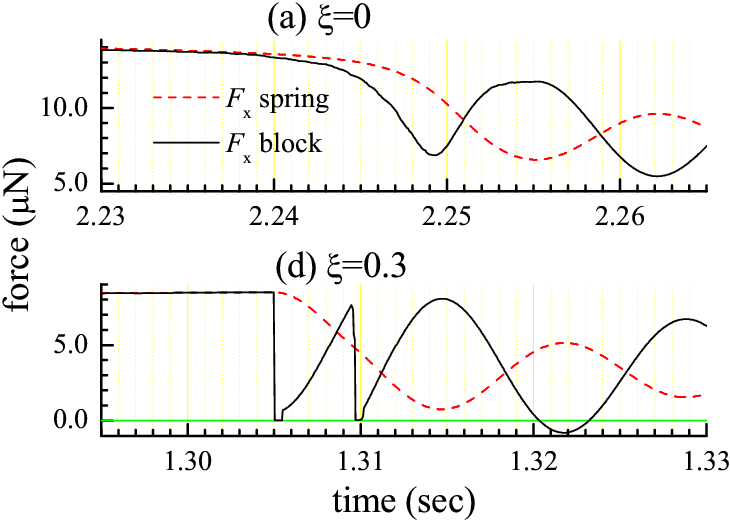
Details of the slip are shown in Fig.stick12: without interaction, contact's detaching is sequential, while for a strong interaction, all contacts detach simultaneously, and the force F abruptly drops to zero. This is clearly demonstrated in Fig.stick12 (compare panels (a) and (d)).
|
|
Figure stick12: The spring force Fd(t) (red dashed) and the force from contacts on the slider F(t) (black solid curve) during slip for noninteracting (a) and strongly interacting (d) contacts. Parameters as in Fig.stick11.
|
The interaction may lead to avalanches as was observed in the EQ simulation: for x=0 the contacts break sequentially, one after another, while for x>0 one contact may stimulate the breaking of nearest contacts, and the average size of avalanche increases with x as demonstrated in Fig.stick13. For a large strength of interaction, x=0.3, the avalanche occupies the whole system (Fig.stick13d).
In tribological community there is a common opinion that the viscosity of a thin confined film is many orders of magnitude higher than the bulk viscosity (P.A.Thompson, M.O.Robbins, G.S.Grest, Israel J.Chem. 35 (1995) 93; H.-W.Hu, G.A.Carson, S.Granick, Phys.Rev.Lett. 66 (1991) 2758). For example, considering the drop of the spring force during slip, Klein (J.Klein, Phys.Rev.Lett. 98 (2007) 056101) came to the conclusion of "high viscosity" of the molten lubricant film, h »104hOMCTS. So large viscosity of a thin film, however, has no reasonable explanation. The cases of a single or two molecular layers confined between two planar surfaces are exceptional in the sense that properties of such films are far from their bulk ones. But already a three-layer film, if it is melted (liquidized) during slips, should exhibit properties not very different from the bulk ones, as follows from almost all MD simulations.
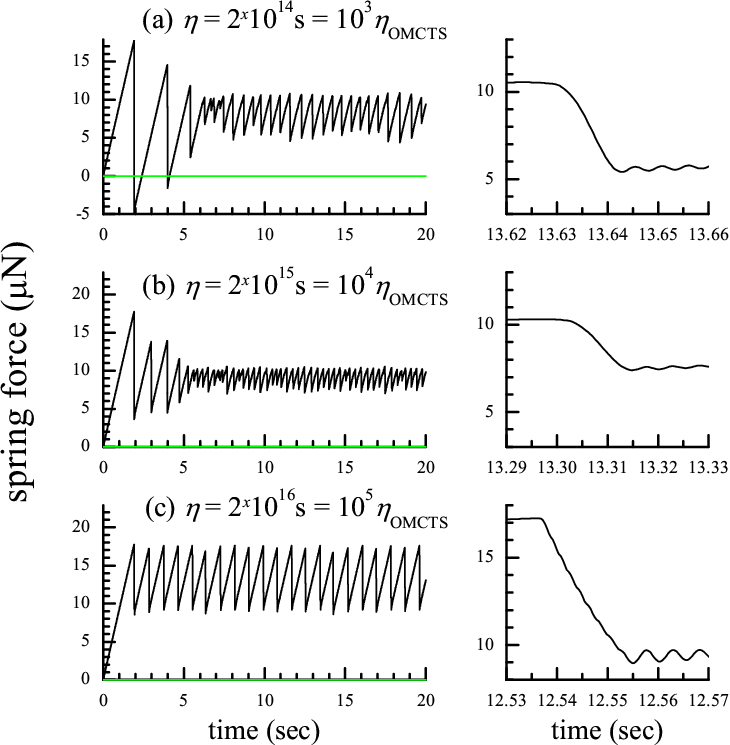
In our model with a distribution of static thresholds, the time ts of F(t) drop is almost solely determined by the setup frequency WS. This time remains approximately unchanged even if we increase the model parameter h (which corresponds to the film "viscosity") in 105 times as demonstrated in Fig.stick17.
|
|
Figure stick17: Dependence of the spring force Fd(t) on time for different values of the lubricant viscosity h
|
The conclusion about a huge viscosity of a thin confined film is based on the assumption that the lubricant film is (ideally) homogeneous and, at the onset of slip, the whole film melts simultaneously so that the further slip proceeds with a liquid film. When the film instantly melts, the force F on the slider from the interface abruptly drops to the viscous force (which starts from zero being proportional to the slider velocity), while the force from the driving spring remains unchanged at the beginning. Therefore, if the slip is viewed as a uniform, massive lubricant melting event, then the limiting factor would be the lubricant's viscosity, and in that case very large viscosity values for the lubricant's viscosity are required, 104 to 107 times higher than that of the bulk lubricant.
However, this assumption has neither experimental nor theoretical support. From surface science physics it is known that a thin film may hardly be homogeneous on a meso- and even nanoscale, as well as the surfaces themselves are not ideally crystalline on these scales. Generally, a film consists of domains with different orientation or even different structure and, therefore, are characterized by different threshold stress yields. Thus, it is reasonable to assume that the film does not melt and begin to slide all at ones, but different domains start to slide one by one, as in the EQ model. In this case, the decrease of F is gradual owing to consequent breaking (melting) of different contacts (domains), and this approach describes the X(t) dependences observed experimentally.
The mechanism of slip onset (either sequential breaking of the contacts or the instant melting of the lubricant film) determines details of the slip kinetics which in principle may be resolved with SFB experiments. The order of magnitude of the slip time, however, in both cases is determined by the setup mechanical frequency WS. Indeed, in our model adapted to the SBF setup, the sliding mass M is concentrated at the end of the spring, i.e., the slider plus spring form a usual pendulum. A pendulum is characterized by two characteristic times – the inverse of its frequency, W-1, and the inverse of its damping coefficient, h-1; whichever of these times is shorter, it determines the system kinetics.
The frequency of ringing vibrations after the slip is either WS (if F(t) oscillates around zero in the case of td>Ws-1) or WL, i.e., much higher in the case of td<Ws-1. However, the question is more involved: in the model we assumed that the bottom substrate is rigid and fixed. In a real setup, only the bottom of the base may be fixed, while the base has its own mass MB and elasticity KB. When the sliding stops and the two substrates are pinned together, the whole system of the mass MS=MB+M+Nm should oscillate with a frequency ~(KB/MS)1/2. Unfortunately, usually we do not know the experimental values for these parameters.
Notice also that, in the case of dF(v)/dv <0 which emerges because of contact's aging, the regimes of stick-slip and smooth sliding may be separated by a regime of irregular (chaotic) motion due to inertia effects.
The ME approach is based on the earthquakelike model, which belongs to cellular automaton model and, thus, ignores real dynamics of contacts' motion. Namely, as the force on a given contact i reaches the corresponding threshold value, the contact instantly relaxes. In a real situation, however, the relaxation is not instant but takes some time; therefore, the delay time is always nonzero, td>0. Moreover, if the interaction between the contacts is taken into account, relaxation of neighboring contacts stimulated by the ith contact, also should propagate not instantly but continuously. This leads to appearance of collective (soliton-like) waves in the sliding interface.
...
|
... Sorry, still under construction ... |
|
... Sorry, still under construction ... |
...
Above we considered the bottom plane of the sliding block as a rigid plane, i.e., we ignored a possible variation (or fluctuation) of F in the (x,y) plane. To develop a full theory of friction on the mesoscale, one has to take into account the elastic deformation of the sliding blocks and the interface by introducing a position dependent distribution Q[x, X(r)], where r={x,y} denotes the position of an asperity on the interface, and X(r,t) describes the local translation of the interface averaged over the mesoscopic scale. The solution of the master equation (or a set of equations if the aging is included) then provides a local force (stress) at the interface F(r,t). The master equation has then to be coupled to an equation describing the elastic deformation of the block with the boundary condition at the interface, subjected to the contact forces F(r,t) at each point r. Besides, one may also take into account a possible heating of the contacts due to sliding. Such a program, of course, may be completed numerically only.
Thus, we described the master equation approach to the earthquakelike model with a continuous distribution of static thresholds, which is much more efficient than simulations and can be solved analytically in cases which are particularly relevant. It provides a deeper understanding of friction analyzed at the mesoscale in terms of the statistical properties of the contacts. This splits the study of friction in independent parts:
(i) the study of the contacts, which needs inputs from the microscopic scale,
(ii) the calculation of the friction force given by the master equation provided the statistical properties of the contacts are known, and
(iii) the incorporation of other aspects such as the interaction between the contacts and their aging.
This approach describes the stick-slip and smooth sliding regimes of tribological systems. The stick-slip motion emerges if and only if the following two conditions are satisfied: first, the slider is soft, K<K*, and second, the delay time in contact formation is nonzero, td>0. If at least one of these conditions is violated, the steady-state motion corresponds to smooth sliding. In stick-slip, the elastic energy stored in the slider during stick when F(t) grows, is then partially dissipated during the force dropping, and partially during the following (ringing) oscillations. The transition from stick-slip to smooth sliding with the increase of the driving velocity emerges due to aging of the contacts (although ringing vibrations may also contribute to the transition mechanism).
Note, however, that the ME approach is to be applied to meso- or macroscopic systems, but it cannot be used to explain the AFM/FFM tip-based experiments, except if there is a multi-contact through several tip atoms.
See the articles (pdf files may be found here):

O.M. Braun and M. Peyrard, Phys. Rev. Lett. 100 (2008) 125501 "Modeling friction on a mesoscale: Master equation for the earthquakelike model"; Phys. Rev. E 82 (2010) 036117 "Master equation approach to friction at the mesoscale"; and in preparation
O.M. Braun and E. Tosatti, Europhys. Lett. 88 (2009) 48003 "Kinetics of stick-slip friction in boundary lubrication"; and in preparation
O.M. Braun, I. Barel, and M. Urbakh, Phys. Rev. Lett. 103 (2009) 194301 "Dynamics of transition from static to kinetic friction"
 Back to
main page or
tribology page
Back to
main page or
tribology pageLast updated on October 26, 2009 by O.Braun. Copyright © by O.Braun. Translated from LATEX by TTH